
Dak Lak Travel Website Design: Tours, Accommodation and Booking Operations
- Published on


A Dak Lak travel website should not be a gallery with a “Book now” button attached. Travelers need to know which tour, room, or experience they are buying; which dates accept guests; how the price is calculated; what is included; when a request becomes confirmed; and how changes, cancellations, and refunds work. The operating team needs one dependable source of data so it does not oversell capacity, quote the wrong price, or lose a request.
RiverLee designs websites for tour operators, activity providers, homestays, and accommodation businesses around the journey from discovery to confirmation. This guide explains how to model products, departures, capacity, booking, payments, traveler data, destination content, and local SEO. If you already have itineraries, room types, or a booking process, contact +84 962 334 807 so we can review the scope before preparing a quotation.
What jobs should a Dak Lak travel website perform?
The website has three simultaneous jobs. For travelers, it is a place to compare itineraries, stays, conditions, and total cost before sending a request. For staff, it collects structured data for checking dates, capacity, prices, deposits, and ownership. For the business, it is an official information source that can be maintained, measured, and connected to other sales channels.
Scope must follow the real operating model. A tour operator needs tours, departures, pickup points, and passenger lists. A homestay needs room types or individual units, occupancy, supplements, and a room calendar. An activity provider needs sessions, participant limits, weather conditions, and preparation guidance. Forcing all three into one generic form simply moves the work back to chat and spreadsheets.
A website also cannot turn fragmented data into a booking system by itself. Before development, the business must decide who updates prices, who opens inventory, which source decides availability, who confirms each request, and how exceptions are handled. Interface, CMS, and integrations should be built on those decisions.
Define the travel product correctly before design
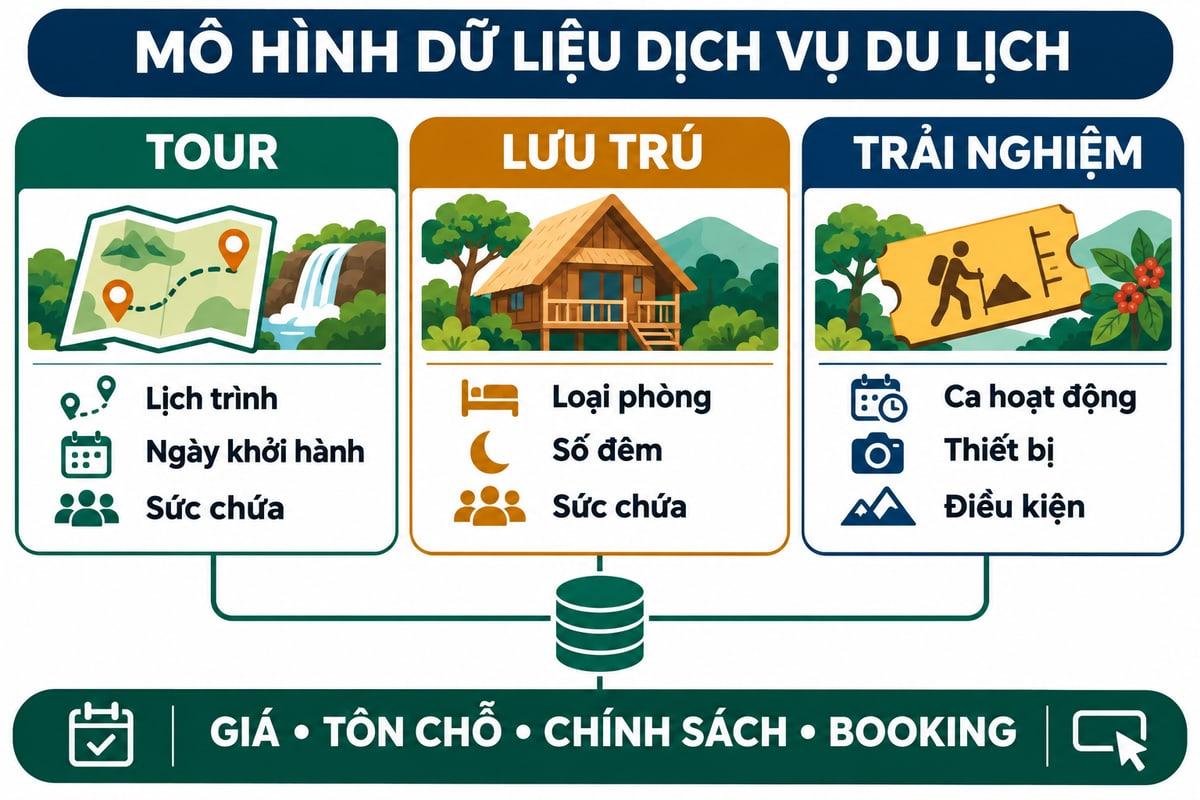
A Dak Lak tour, a homestay room, and an activity ticket are different product types. Each has its own selling unit, schedule, capacity, policy, and traveler data. A model containing only title, image, price, and description will soon push critical details into messages or offline files.
A tour has an itinerary and separate departures
A tour needs an identifier, name, duration, pickup point, itinerary, inclusions, exclusions, participation conditions, price groups, minimum and maximum capacity, and applicable policies. A departure is a separate record because the same tour can have different prices, places, guides, or selling states on each date.
The page should separate stable content from changing data. The sample itinerary, activity level, and destination context can remain stable; departure dates, available places, supplements, and offers need effective dates. This separation lets staff update one record without erasing history or applying a new price to an older request.
If a tour operates only after reaching a minimum group size, the website must label the date as proposed or accepting registrations. “Places available” does not necessarily mean “departure guaranteed.” Buttons and notifications should use accurate language so travelers do not make other commitments based on an unconfirmed departure.
Accommodation inventory may be a room, unit, or room type
A homestay, small hotel, or farmstay must define its inventory unit. Selling a specific room makes sense when rooms differ; selling a room type works when several units are equivalent; an entire property needs its own occupancy, bedroom, and use rules. The website must know what a request holds, across which nights, and for how many guests.
A room-type page should show area, bed configuration, standard and maximum occupancy, amenities, shared areas, check-in and check-out times, supplements, and images of that type. Do not use the best unit to represent all options when the delivered room could differ materially.
Availability is calculated by night and must handle arrival and departure dates. If the site is not connected to a trustworthy inventory source, use an availability request and manual confirmation. A fabricated “available” calendar may improve clicks briefly but creates double bookings and damages trust.
Experiences and activities operate by session or capacity
Coffee workshops, farm visits, boat activities, forest trips, and cultural programs often sell by session. Their data can include start time, duration, meeting point, age or fitness restrictions, preparation, capacity, weather conditions, and alternatives. Some activities depend on equipment or qualified guides, so capacity is not merely the number of seats.
The site should distinguish open, held, full, closed, and canceled sessions. Shared departures need a minimum size and decision deadline. Weather-dependent activities need a policy explaining who decides to stop, how guests are notified, and whether they can reschedule or receive a refund.
Build tour and accommodation pages that support a decision
A service page should answer essential questions before a traveler transfers money or supplies personal data. The objective is not length for its own sake. Comparable facts belong near the top, operational details near the booking action, and complete policies where a traveler can read them before accepting.
Itineraries should explain pace and conditions
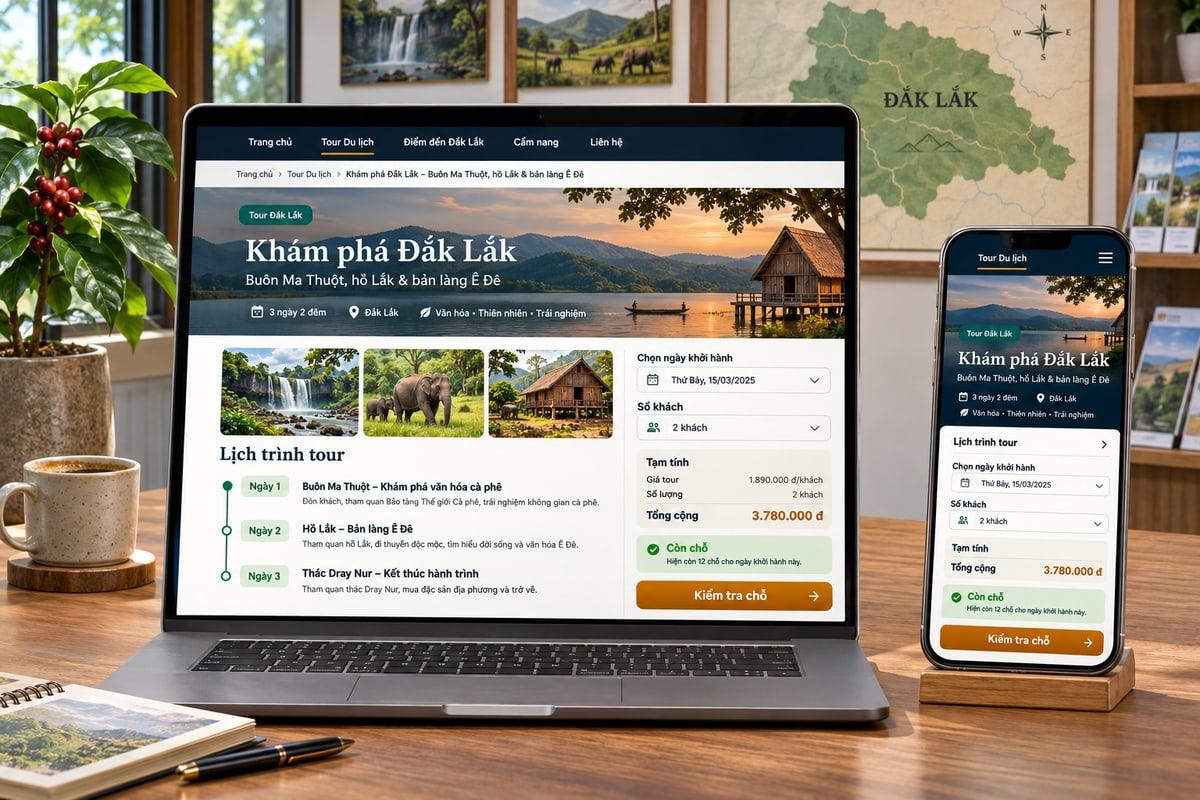
A day-by-day or session-by-session itinerary should identify the start, approximate transfers, main activities, meals, accommodation, and expected times. For journeys around Lak Lake, Buon Don, Yok Don, or local waterfalls, explain walking level, terrain, weather effects, and the actual pickup point instead of relying on generic adventure language.
Destination details change. Pages should record an editorial source and review date, especially for opening hours, access, entrance charges, or protected-area rules. The provincial portal publishes an official overview of Dak Lak attractions; operators still need to verify conditions directly before each program.
Do not copy another publisher’s destination description and present it as your itinerary. The page should reflect the service actually provided, its transport, owner, and current conditions. Original operational detail helps both traveler decisions and search quality.
Prices need a unit and an effective date
“From VND 1 million” is incomplete unless the traveler knows whether it is per person, room, night, group, or package. State guest categories, minimum party size, child rules, single supplements, holiday surcharges, remote pickup, and exclusions. Where price depends on party size, use tiers or a quotation workflow instead of one misleading number.
Prices need an applicable season or effective date. Store versions so older requests retain the price that was shown. Discount codes and offers need conditions and should not stack unless the policy permits it.
Before confirmation, explain the total: base price, quantity, supplements, discounts, applicable tax or fees, deposit received, and balance. Transparent calculation supports consumer information and dispute prevention better than a simplified headline price.
Images and reviews need a legitimate source
Tour images should represent the route, period, or service class being sold; room images should match the selected option. Label illustrative media. Where travelers appear, manage the basis for use, public scope, and removal requests. A famous destination image should not imply that an activity is included when it is not.
Reviews should be genuine, attributable within the permitted scope, and contextual. Do not invent names, scores, or quotations. If review data enters structured data, the marked-up content must be visible and follow Google’s review snippet guidelines.
Large images need compression, suitable dimensions, and alt text that describes what is visible. Our image SEO guide explains naming, formats, and performance without keyword stuffing or altering the represented service.
Design departures, inventory, and service capacity
Availability is reliable only when it comes from the source staff use to confirm a booking. If the website, intermediaries, phone team, and agents maintain separate counts, the displayed number can become wrong as soon as another channel accepts an order.
Every sellable date needs its own state
Each departure or activity session can have an identifier, date and time, pickup point, capacity, confirmed places, active holds, hold expiry, and status. Useful states include proposed, open, nearly full, full, closed, departed, and canceled.
The public does not need every internal state, but the message must correspond to it. “Request a place,” “Available,” “Awaiting confirmation,” “Sold out,” and “Contact us” are different promises. A universal “Book now” button obscures what happens next.
The sellable date also needs the relevant price and policy version. If a holiday departure uses a different cancellation policy, attach it to the applicable departure or rate rather than hiding it in a general footer.
Sellable capacity must subtract active holds
Sellable places differ from nominal capacity. Subtract confirmed places, unexpired holds, agent allocations, and constraints from vehicles, rooms, boats, or guides. Return places only when a hold expires or a failed transaction is released under a defined rule.
Rooms need date-range logic and may require housekeeping buffers. Sessions can require equipment in specific sizes or a guide with particular skills. Shared tours have both minimum and maximum group constraints.
The first release does not need complete automation. A staff-approved calendar and a pending request are safer than “real-time” availability without an authoritative source. Automate after data ownership, permissions, and conflict handling are stable.
Multiple sales channels need one reconciliation rule
A business may receive requests through its website, phone, Zalo, agents, and OTAs. Define which channel can hold inventory, synchronization timing, who resolves duplicates, and which source has final authority. Without an API, staff need a disciplined update schedule and change log.
Each record should retain source, external reference, owner, and status history. These fields support commission reconciliation, channel analysis, and cases where one traveler contacts two channels. A shared inbox without identifiers or ownership is not a booking process.
Design a booking journey with explicit states
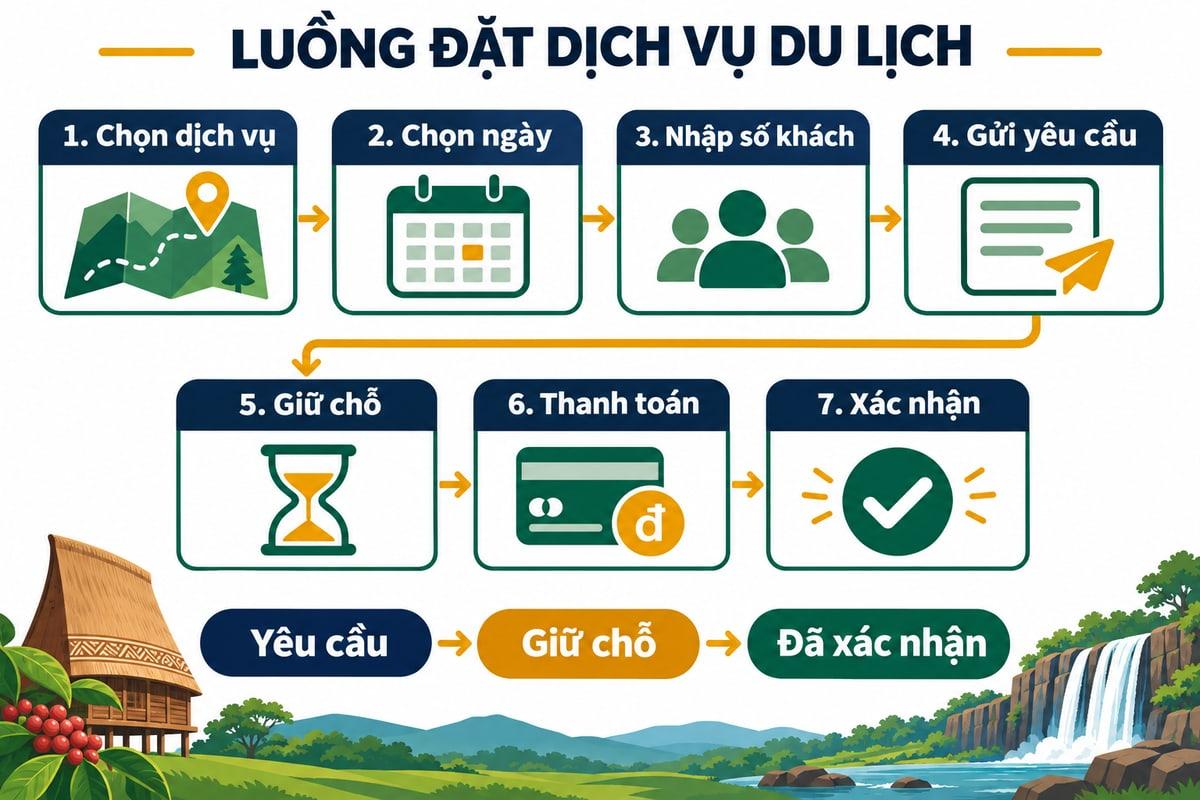
Booking is a sequence of state changes, not one form submission. Travelers need to know the current state, what is missing, and when capacity is actually reserved. Staff need one shared state so one person does not promise a place that another has already assigned.
Distinguish a request, a hold, and a confirmation
A request records the traveler’s need without a supply commitment. A hold temporarily locks resources until a deadline or condition. A confirmation commits the operator to the specified service, price, and terms. Use these meanings consistently in buttons, emails, thank-you pages, and staff screens.
For manual confirmation, explain the service hours and expected channel without promising an absolute response time the team cannot maintain. Automatic confirmation requires inventory, price, and payment to be checked together to prevent overselling.
Log each material change: actor, timestamp, previous state, new state, and notification result. The audit trail supports dispute handling and shows where work is delayed.
Collect only what the current step needs
An availability request usually needs the service, date, party size, price-relevant age groups, tentative pickup, and contact method. Identity documents, passport data, medical needs, or other sensitive details should wait until they are genuinely necessary and protected appropriately.
The form should preserve page context: tour or room identifier, selected date, language, source, and displayed price. Asking the traveler to retype the product name into notes creates errors and makes reconciliation harder.
After submission, display a request number, data summary, current state, next step, and correction route. A generic “Thank you” leaves the traveler unsure whether the request was recorded.
Notifications should follow events
Email or messages should be triggered by receipt, hold, missing information, confirmation, payment reminder, reschedule, cancellation, or refund. Templates must use data from the correct record rather than manual copy-and-paste that can introduce wrong dates or amounts.
Notifications do not replace a status view. Messages can fail, so complex bookings benefit from a lookup page with appropriate authentication. Staff also need delivery history and failure results so they can intervene.
Every template should identify the booking, service, date, current state, and a safe contact route. Test language variants, missing optional fields, and long names so important conditions are not truncated or sent in the wrong language.
Connect prices, deposits, payments, and refunds
Payment is one part of booking. The system should distinguish amount due, attempted transactions, successful transactions, allocated deposits, and refundable balances. A single paid/unpaid flag is not sufficient for reconciliation or changing a tour.
Deposit policy belongs to the product
Deposits may vary by tour, room, holiday, party size, or lead time. Show the amount or calculation, deadline, holding condition, and remaining balance. Do not request a deposit without making the applicable cancellation policy available.
Payment does not always mean the booking is confirmed if the business still needs to verify supply. The journey should say whether a payment awaits reconciliation or triggers confirmation. If the service cannot be supplied, provide a replacement or refund process.
Every booking should retain the policy version the traveler accepted. Later content edits must not erase the basis for older records.
Transaction state must remain separate from booking state
A booking may be held while payment is pending; a transaction may succeed while operational review is pending; a booking may be canceled while a refund remains open. Model both state axes and their transition rules.
A payment integration must handle repeated requests, delayed callbacks, closed browser windows, failed payments, and reconciliation. Do not trust the browser success page as the only source. Our online payment integration guide covers the technical states worth including in the specification.
Card details should not pass through the website server when the payment provider offers a secure hosted flow. Permissions to view transactions, export reports, and issue refunds should be role-specific.
Changes, cancellations, and refunds need executable rules
Policies should define deadlines, retained amounts, force-majeure handling, third-party services, and the request method. For tours dependent on weather or minimum size, separate operator cancellation from traveler cancellation.
When moving a booking, calculate the difference, transfer the deposit, and link old and new records. A refund needs the original transaction, amount, reason, approver, and reconciliation status.
Make policies easy to find before booking. Vietnam’s Law on Protection of Consumers’ Rights 19/2023/QH15, effective 1 July 2024, is a relevant basis for reviewing information and consumer-transaction duties; consult the official text and professional advice for a specific case.
Protect traveler data and trip records
A travel website may process names, contacts, travel dates, party lists, documents, dietary requests, child information, and payment history. This is more sensitive than a generic contact form, so data needs a lifecycle rather than indefinite collection.
Collect data at the appropriate operational stage
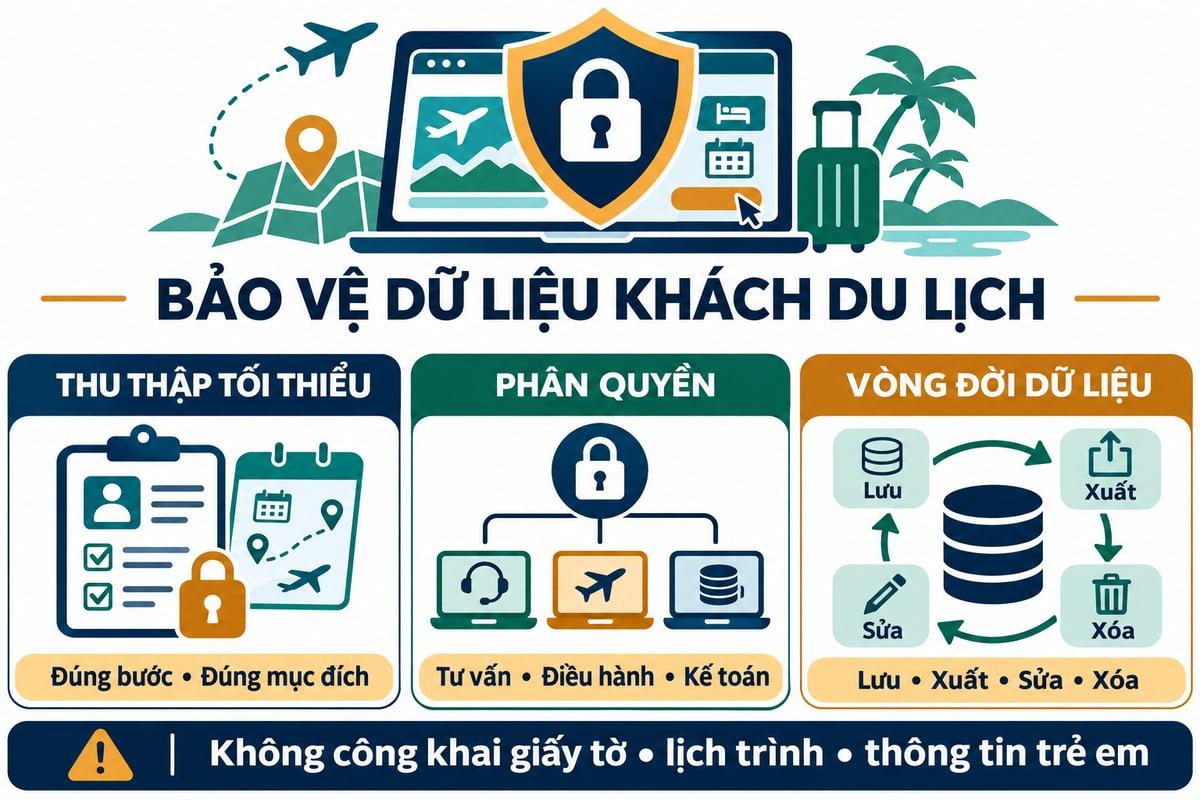
An availability enquiry should collect only enough to assess service. Request contract, insurance, passenger-list, or procedural information after confirmation when necessary. Staging reduces sensitive data held for leads that never become bookings.
Each field needs a purpose, user, retention rule, and processing basis. Do not combine service fulfilment and marketing permission in one choice. When forms, CRM, email, analytics, or payment providers are involved, know where data travels and who can access it.
Vietnam’s Law on Personal Data Protection 91/2025/QH15 took effect on 1 January 2026. Review the process against the official legal text; a generic privacy template is not a complete program.
Grant access by role and trip
Sales may need contact and requirements; operations need service and passenger data; finance needs transactions; a guide should receive only the assigned trip data required for delivery. Every account should not see the entire customer history.
Access can be scoped to location, department, or departure and logged for viewing, editing, and export. Remove access when employment or assignment ends. Exported passenger lists also need a recipient, use period, and disposal method.
Admin accounts need strong authentication, software updates, backups, and recovery procedures. Our business website security guide provides controls for acceptance and ongoing operations.
Manage retention and traveler requests
Data should move through states such as unconfirmed lead, active booking, completed trip, dispute, and expired record. Retention depends on purpose and applicable obligations, not a permanent default.
The business needs a process to locate, export, correct, restrict, or delete data as appropriate. Removing a record from the interface while copies remain in spreadsheets, email, and personal devices is not complete lifecycle management.
During an incident, audit logs and a system inventory support faster scoping. Provide a dedicated privacy contact instead of forcing travelers to use the booking form.
Present the business identity and service scope accurately
A website does not replace licenses or operating conditions. It should identify the provider, direct or intermediary role, scope of tours, accommodation, or activities, and the party responsible for each service.
Publish verifiable business information
The footer and contact page should show the legal or registered business name as appropriate, address, phone, email, and complaint channel. If the brand differs from the legal name, explain the relationship.
Tour operators should verify their licensed scope and details before publishing. Vietnam’s Law on Tourism 09/2017/QH14, effective 1 January 2018, is the primary source; consult the official text and professional advice for applicable duties.
Do not display certification badges, public-agency logos, or partner names without permission. A partner page should explain who delivers each component and who handles changes.
Separate inspirational content from the sold service
A guide can introduce a destination and a suggested itinerary, while a sales page must define the offered service. If a destination appears in editorial content but not in the tour, do not connect a misleading “Book this tour” action.
Opening hours, access, seasons, and destination rules need a review date and source. Where facts are uncertain, tell travelers to verify rather than making an absolute claim.
Community and cultural content should respect the people represented, names, and filming boundaries. Do not promise rituals, community access, or animal interactions that the operator cannot control or substantiate.
Review ecommerce duties against the transaction flow
An informational website that accepts an enquiry differs from one that enables booking, payment, or contract formation. When transactions open, review service information, terms, confirmation, and applicable ecommerce procedures.
Vietnam’s Law on E-Commerce 122/2025/QH15 takes effect on 1 July 2026 and is available on the Government portal. The Ministry of Industry and Trade also publishes the current sales-website notification procedure. Applicability depends on the actual functionality, not the page name alone.
The operator should document which party accepts the order, receives money, issues documents, and handles complaints. A marketplace-like flow, direct sale, and referral form may carry different responsibilities, so legal review must follow the implemented model.
Choose a brochure site, booking engine, or operations system
These layers solve different problems. A brochure site publishes services and accepts requests. A booking engine checks availability, calculates prices, and confirms under rules. An operations system manages departures, rooms, transport, suppliers, passenger lists, and reconciliation.
A brochure site fits manual confirmation
This model suits a small catalog, variable schedules, or supply that still requires partner checks. It can provide service pages, policies, context-preserving forms, and a basic lead dashboard. Staff confirm availability and price before requesting a deposit.
Use accurate actions such as “Send a request” or “Check availability.” Even this version can measure source, response time, and qualified-request rate to prepare for an upgrade.
Manual confirmation still needs request identifiers, ownership, status history, and a response standard. It should not mean forwarding an unstructured email until someone happens to notice it.
A booking engine fits structured inventory and pricing
When departures, capacity, rates, supplements, and policies are structured, a booking engine can let travelers select, hold, enter data, pay, and receive confirmation. It must handle inventory contention, hold expiry, and payment callbacks.
The engine does not necessarily replace a hotel system or OTA. Integration can use an existing source, but the direction, frequency, and failure rules must be defined. Specifications should rely on actual API documentation and account permissions, not vendor marketing.
Pilot one product or room type and reconcile both systems before expanding. Staff need a visible synchronization status and an exception queue so a failed update does not silently create overselling.
An operations system is a separate business project
Allocating vehicles, guides, rooms, meals, suppliers, passenger lists, payables, and profit reporting goes beyond a marketing website. It requires role, workflow, exception, and historical-data discovery as a business system.
Do not force everything into the first release. Separating public content, booking, and operations improves access control, allows interface changes, and limits the effect of integration failures.
The business should justify each operations feature with an owner, input, output, and measurable problem. A large dashboard without reliable source data merely hides spreadsheet inconsistency behind a new interface.
Build local SEO from verifiable local data
Dak Lak travel SEO is not the repetition of “Buon Ma Thuot” or “Dak Lak.” Pages demonstrate local relevance through real pickup points, itineraries, addresses, access guidance, media, policies, and ownership.
Build service pages for real products
Each tour, room type, or experience should have a stable URL, distinct title, comparable data, and policy links. Do not generate pages that only swap place names while the service and content remain the same.
Destination pages can answer pre-trip questions and link selectively to relevant products. A useful cluster may contain a Dak Lak hub, area or destination pages, tour pages, and guides. Breadcrumbs and internal links clarify these relationships for users and search engines.
Update the canonical page when seasonal facts change rather than creating annual copies with no new value. Search Console reveals queries and landing pages, but interpret the data alongside seasonality, advertising, and capacity.
Keep the website and Google Business Profile consistent
Business name, address, phone, hours, category, and URL should agree. Multiple locations need individual pages with distinct data, images, directions, and contact routes rather than duplicated text.
Collect reviews under platform policies. Do not exchange rewards for positive wording or solicit only satisfied customers. Respond with useful information and move booking-specific issues to a private channel to avoid exposing personal data.
Our local SEO guide explains how location pages, business profiles, citations, and measurement work together without promising a fixed position.
Choose schema for the actual page type
A business page may use LocalBusiness and an appropriate subtype when visible information supports it. Tour or service pages can use suitable schema.org types, but not every type produces a rich result. Mark up only visible and truthful content.
Do not add VacationRental merely because the property calls itself a homestay. Google’s VacationRental documentation describes eligibility and data requirements involving Hotel Center; it is not a shortcut for every small lodging website.
After implementation, use Rich Results Test and Search Console to detect errors. Structured data helps machines understand content; it does not guarantee a rich result or ranking.
Implement features in three phases
Phasing lets the operator publish trustworthy information, measure the process, and then automate. Each phase needs acceptance evidence and an owner, not only a feature list.
Phase 1: services, local content, and structured enquiries
Build tour, room, experience, destination, policy, and business pages; use context-preserving forms and an intake dashboard. Standardize identifiers, prices, dates, approval ownership, and media rights. The objective is to reduce repeated questions and know every request’s status.
Measure qualified requests, response time, loss reasons, and source pages. If service data remains inaccurate or staff do not update states, do not open payment yet.
Acceptance should prove that staff can publish a product, receive a contextual request, assign it, update its state, and find its history. These basics create the operating discipline needed for later automation.
Phase 2: availability, holds, and payment
Add sellable dates, capacity, holds, deposits, event notifications, and reconciliation. Pilot a small product set and simulate full capacity, delayed payment, changes, cancellations, and refunds.
Automate confirmation only when inventory is dependable. Cases outside the rule should reach staff with full context rather than trap the traveler.
Completion criteria include non-negative inventory, a stored booking price, reconcilable transactions, and notification history. Keep manual confirmation for any part that cannot yet meet those criteria.
Document the rollback and support route before opening the payment flow to all products.
Phase 3: channels, locations, and deeper operations
Connect inventory, CRM, or operations tools after API access is verified. Add a customer portal, passenger lists, resource allocation, payables, or reporting where operations justify them.
Every integration needs monitoring, error queues, and fallback procedures. Controlled automation is better than a large system no one can correct when data diverges.
Prioritize integrations that remove a measured recurring error or workload. A connection added only to complete a technology list creates another failure point and ongoing support cost.
Review performance and error volume after each release before committing to the next connection.
Dak Lak travel website design process
RiverLee uses seven steps. Scope varies by model, but data discovery, content approval, and operational testing remain essential.
Step 1: inventory products, authority, and sales channels
List tours, rooms, experiences, pickup points, sellable dates, rate groups, policies, documents to verify, and current channels. Identify the provider, content owner, and authoritative inventory source for each service.
The result is a scope document and missing-data list. It prevents design around a fictional sample tour.
Record unresolved points as assumptions with a decision owner. The quotation should separate confirmed scope from integrations that require documentation, credentials, or technical discovery.
This makes the commercial boundary understandable to both the client and delivery team.
Step 2: map traveler and internal journeys
Describe discovery through completion or cancellation: content viewed, selections, data supplied, staff checks, holds, deposits, and confirmation. Include insufficient group size, no room, weather, delayed transactions, and participant changes.
Assign every state an owner and notification. These decisions become form, dashboard, and acceptance criteria.
Walk through one normal booking and several failure scenarios on the map. This exposes missing owners, repeated entry, and unclear handoffs before they become expensive code changes.
Record decisions and open questions directly on the journey so they remain traceable.
Step 3: create content architecture and a prototype
Define page types, navigation, filters, tour–departure–destination relationships, and policy placement. The mobile-first prototype should support comparison, date review, price understanding, and enquiry.
Test with real long names, supplements, and sold-out cases. Short placeholder content does not reveal operational layout problems.
Approvers should complete tasks on a phone rather than only view static desktop screens. Revise confusing steps before development so the built interface starts from validated decisions.
The approved prototype becomes the reference for content, interaction, and responsive acceptance.
Step 4: develop the CMS, booking, and integrations
Build the interface, data model, roles, forms, calendar, email, and scoped integrations. Test environments use separate credentials and must not trigger real transactions or guest messages.
Every integration needs logs and failure handling. Performance, accessibility, and technical SEO are tested during development.
Keep shared documentation for states, data fields, and rules. Testers can then compare behavior with an agreed specification instead of relying on individual expectations.
Changes during development should update that reference and identify the affected tests.
Review it at every milestone.
Step 5: enter real data and obtain operational approval
Enter services, dates, rates, media, policies, and business information. Operations approves schedules, finance approves pricing and deposits, management or counsel reviews policies, and marketing verifies content rights.
The EN version should be professionally edited and updated with the VI source. Do not launch a language the team cannot support or keep synchronized.
Before content freeze, compare prices, dates, pickup points, conditions, policies, and links automatically and manually. Unapproved records stay in draft rather than appearing with partial data.
Preserve the reviewer and approval time for fields that affect a booking decision.
Step 6: test end to end, including security and performance
Run landing page through request, hold, payment, confirmation, change, cancellation, and refund. Test concurrency, hold expiry, repeated callbacks, network loss, email failure, price changes, and incorrect permissions.
Check real devices, mobile networks, heavy images, Core Web Vitals, keyboard forms, metadata, canonical, hreflang, schema, sitemap, backup, and recovery. Inventory or money defects block launch.
Test results need evidence, severity, and ownership. After a fix, rerun the affected flow and regression checks so a change does not break another price, notification, or permission.
Step 7: train, launch in a controlled scope, and monitor
Train by role and hand over documentation, accounts, source code, and support procedures. For complex booking, launch with a limited product or date set.
Monitor qualified requests, response time, payment errors, inventory divergence, completion, and recurring questions. Use evidence to prioritize improvements rather than promise a generic growth rate.
During stabilization, define one issue owner and an agreed review cadence. Afterward, move to scheduled maintenance, content reviews, permission audits, and integration checks.
Keep release notes so staff understand which workflow or data rule changed.
Dak Lak travel website design cost
RiverLee publishes starting prices in public/pricing.md. BASIC TYPE starts from VND 2,000,000 for a template-based site and basic functions; PREMIUM TYPE starts from VND 5,000,000 for custom design. A standard site is estimated at 7–30 working days, while a large project may take 1–3 months, depending on data, integrations, and approval speed.
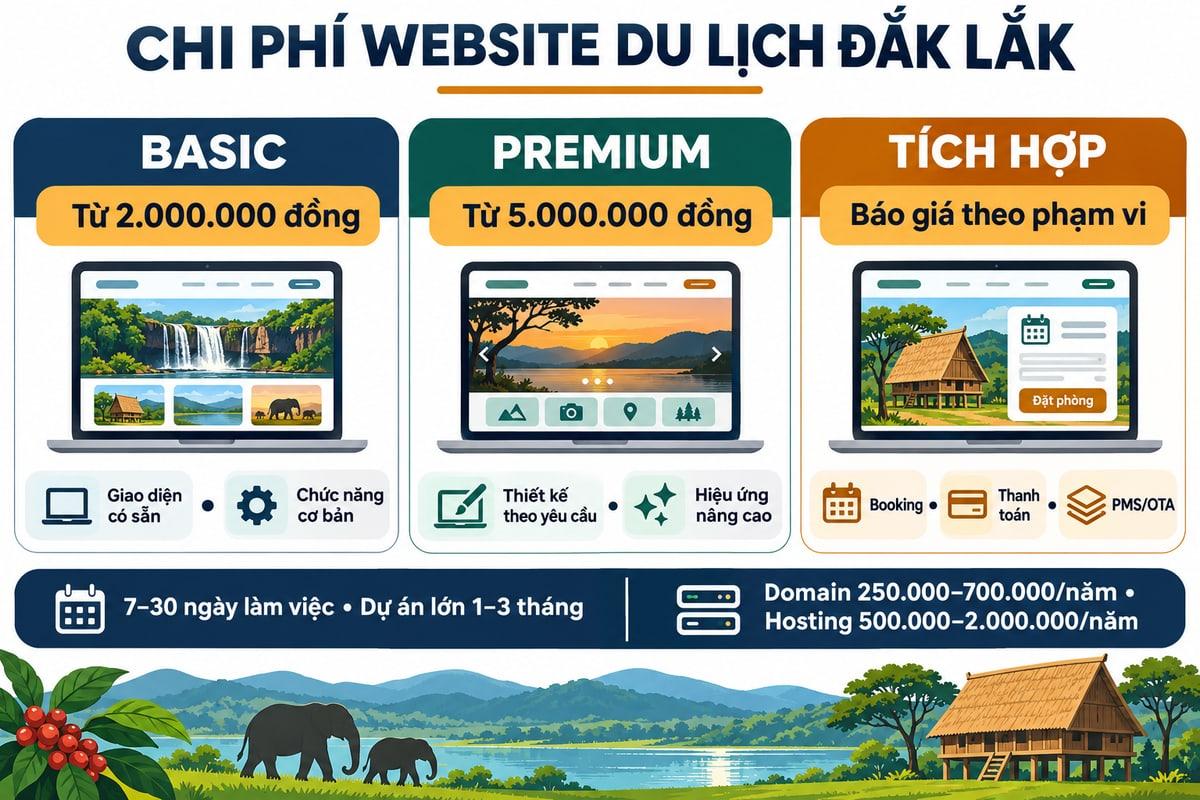
A brochure site with service pages and an enquiry form is closer to basic scope. Availability, multiple rate groups, languages, payment, a customer portal, PMS/OTA synchronization, or operations software requires discovery and a separate quotation. A proposal that says “tour booking” should specify whether it means a pending form or an inventory-aware booking engine.
Every tier includes responsive implementation, speed optimization, SEO foundations, first-year SSL, admin training, source-code handover, and a 12-month warranty under the published terms. Potential extras include a domain at approximately VND 250,000–700,000 per year and hosting at approximately VND 500,000–2,000,000 per year; media production, translation, software licenses, payment charges, and third-party providers should be itemized.
When comparing providers, ask for page templates, data model, entry limits, booking states, integrations, content responsibilities, performance criteria, ownership, and post-launch support. Our website design pricing guide gives a structured way to compare quotations.
Pre-launch checklist
Before public launch, confirm:
- Every tour, room, and experience has an identifier, provider, and update owner.
- Itinerary, pickup, capacity, price, supplements, and effective dates are approved.
- Calls to action distinguish request, hold, payment, and confirmation.
- Sellable inventory subtracts active holds and has expiry rules.
- Change, cancellation, refund, weather, and minimum-group policies appear before booking.
- Media, reviews, and partner logos have a source and usage rights.
- Forms collect only necessary data and stage sensitive fields.
- Roles, logs, backups, and access revocation have been tested.
- Failed, repeated, and delayed transactions plus refunds have been tested.
- Business identity, service scope, and complaint channels are verifiable.
- VI and EN prices, dates, and policies agree and have owners.
- Canonical, hreflang, sitemap, robots, schema, and Search Console are checked.
- Links, forms, emails, and images work on real devices.
- A dashboard tracks qualified requests, response time, errors, and source.
- Staff know the fallback process for a website or integration outage.
The checklist needs an owner and evidence. One successful test booking is not enough; failure paths and exceptions matter equally.
Frequently asked questions
Does a small operator need a booking engine immediately?
Not necessarily. If schedules vary, inventory is fragmented, or staff still confirm with several suppliers, a brochure site with a structured request is safer. Measure response time, loss reasons, and data accuracy first. Automate holds and confirmation after dates, prices, capacity, and policies have an authoritative source.
The form version still needs a request number, owner, and status. “Manual” should describe a controlled human decision, not an untracked message in a shared inbox.
It can later become the intake layer for automation without rebuilding every service page.
Can the website synchronize rooms or tours with an OTA?
Possibly, when the existing system provides an appropriate API or channel manager. Verify the data types, direction, latency, limits, access, and fees before estimating. Define failure behavior and the final source of truth. Do not promise real-time synchronization based only on a platform name without checking the actual account and documentation.
Start with one room type or tour group and compare results on both sides. Synchronization logs must let staff identify and correct the failed record.
A manual fallback should remain available during provider outages or credential changes.
Should travelers pay the full amount online?
It depends on inventory reliability, policy, and reconciliation. A deposit may fit capacity that needs to be held; full payment may fit firmly available services. In either case, display conditions, separate booking and transaction states, and handle failure, change, cancellation, and refund.
Also account for gateway fees, settlement timing, and refund permissions. These factors affect the finance workflow and the support experience after payment.
Test a small-value transaction and refund before accepting real customer payments, and retain the reconciliation evidence.
How often should destination content be updated?
Update when access, hours, fees, seasons, rules, or services change; no fixed publishing frequency fits every page. Give important content an owner, source, and review date. Correct pages that influence booking decisions before publishing more generic articles.
If a fact cannot be verified, replace the stale number with a direct-check instruction. Material updates should trigger a review of links, structured data, and translated versions.
Archive or redirect obsolete pages so travelers do not reach conflicting guidance from search.
Record why the change was made.
How long does a Dak Lak travel website take and what does it cost?
RiverLee’s published starting prices are VND 2,000,000 for BASIC and VND 5,000,000 for PREMIUM. A standard website takes an estimated 7–30 working days; a large project can take 1–3 months. Booking engines, languages, payment, inventory synchronization, and operations systems require separate discovery. The official quotation should define data, states, integrations, and acceptance criteria.
The schedule begins after scope and required inputs are agreed. Late content, media, API access, or operational decisions can change the estimate and should be recorded in the project plan.
Conclusion
An effective Dak Lak travel website starts with real data and operations: what is sold, which dates operate, how much capacity remains, how prices are calculated, when a request becomes confirmed, how money is reconciled, and who protects traveler data. A polished interface creates value only when these answers agree across the website and the team.
RiverLee can help standardize tours, rooms, or experiences; implement the website in phases; integrate once the source data is ready; and hand over a maintainable system. Contact Hotline/Zalo +84 962 334 807 to review your existing data, select a suitable scope, and receive a transparent quotation.
For an initial review, bring the current product list, availability or inventory sheet, policies, and active sales channels. This evidence separates work that can begin immediately from data that needs standardization, reducing assumption-based estimates and late scope changes.
The resulting roadmap should name the first release, deferred integrations, operating owners, and the evidence required before each later phase can launch safely.
Related tags:
Dak Lak travel website designBuon Ma Thuot tour websiteDak Lak homestay websiteOnline tour bookingLocal travel SEORiverLeeComments
0 Comment(s)
Loading...
Latest Posts

Web Design by Province and City: Vietnam Location Guides
Browse RiverLee's Vietnam web design guides by province and city, with location-specific advice on business models, scope, costs, local SEO and acceptance.

Vung Tau Web Design for Tourism and Local Businesses
A Vung Tau web design guide for tourism, services, and B2B companies covering structure, features, costs, local SEO, delivery, and acceptance testing.

Quang Ngai Web Design for Tourism, Industry and B2B
Quang Ngai web design for Ly Son tourism, accommodation, local products, and Dung Quat B2B: structure, features, pricing, process, and QA checklist.

Ninh Binh Web Design for Tourism and Local Businesses
Ninh Binh web design for heritage tourism, accommodation, and businesses: content structure, features, pricing, local SEO, process, and acceptance checks.
Related Posts
Web Design by Province and City: Vietnam Location Guides
Browse RiverLee's Vietnam web design guides by province and city, with location-specific advice on business models, scope, costs, local SEO and acceptance.
Vung Tau Web Design for Tourism and Local Businesses
A Vung Tau web design guide for tourism, services, and B2B companies covering structure, features, costs, local SEO, delivery, and acceptance testing.
Quang Ngai Web Design for Tourism, Industry and B2B
Quang Ngai web design for Ly Son tourism, accommodation, local products, and Dung Quat B2B: structure, features, pricing, process, and QA checklist.
Ninh Binh Web Design for Tourism and Local Businesses
Ninh Binh web design for heritage tourism, accommodation, and businesses: content structure, features, pricing, local SEO, process, and acceptance checks.
