
Web Design in Buon Ma Thuot: From Company Website to Customer Acquisition Channel
- Published on


RiverLee provides Buon Ma Thuot web design for local SMEs, coffee and agriculture brands, tourism operators, retailers, and professional services. We connect RiverLee’s home-market understanding with product, booking, consultation, and local customer journeys. For an initial scope review, call 0962.334.807.
Businesses searching for BMT web design rarely need an attractive interface alone. They need an official channel where customers can verify credibility, examine products, read policies, and take a useful action such as calling, booking, requesting a quotation, or purchasing. In Buon Ma Thuot, that need spans specialty coffee shops, agricultural companies, accommodation providers, restaurants, clinics, education centers, retailers, and professional services. An effective website must therefore begin with the sales process and verified business data rather than a visual template. This guide explains how to choose a suitable website model, prioritize features, estimate costs, prepare local SEO, and define acceptance criteria before signing a contract.
How RiverLee supports businesses in Buon Ma Thuot
RiverLee starts with the customer action and the operating process behind it. The project defines the information visitors need, the data staff must receive, the confirmation state, and the person responsible for the next step. This keeps the website useful after launch instead of leaving enquiries, bookings, or orders in an unmanaged channel.
With more than two years of delivery experience and over 100 completed websites, RiverLee works with WordPress and Next.js according to the required publishing workflow, performance, customization, and integrations. Projects can be coordinated remotely through documented milestones, with on-site work arranged when research, photography, or training requires it. Delivered websites include a 12-month warranty within the agreed scope and practical administrator guidance.
The client retains control of accounts and data. The scope focuses on maintainable, testable customer journeys rather than unsupported promises of rankings or revenue.
Why does a business in BMT need its own website?
An owned website is a durable brand-verification point. A Facebook page, marketplace listing, Google Business Profile, and messaging app can all be valuable, but their presentation, customer data, and reach depend on third-party policies. A website lets a business publish consistent information, explain its offer in depth, retain useful content, and shape the conversion path around its actual operation. It also provides a stable destination for search, paid media, printed materials, QR codes, and referrals.
Buon Ma Thuot has a local context that must be represented accurately. Following the 2025 administrative reorganization, ward names and address conventions changed in several locations. The local government portal states that Buon Ma Thuot Ward was established under Resolution 1660/NQ-UBTVQH15 dated June 16, 2025. Businesses should consequently reconcile their address across the website, Google Business Profile, invoices, maps, and relevant directories. Source: Buon Ma Thuot government portal.
A website does not automatically produce revenue or search rankings. Its value comes from helping a prospective customer understand the offer, establish sufficient trust, and complete the next step with little friction. A visually elaborate page that lacks price context, policies, authentic images, or a responsible person for form submissions will underperform a simple site that is fast, clear, and consistently operated. Start with one priority outcome—calls, reservations, quotation requests, bookings, or orders—and use it to guide structure, content, measurement, and follow-up responsibilities.
Choose the website model according to the business sector
Every model below needs different data, proof, calls to action, and operating ownership. Choose one priority journey, identify the authoritative source for each important field, and define who confirms the result after submission. This approach prevents the first release from becoming a collection of attractive but disconnected features and makes acceptance measurable.
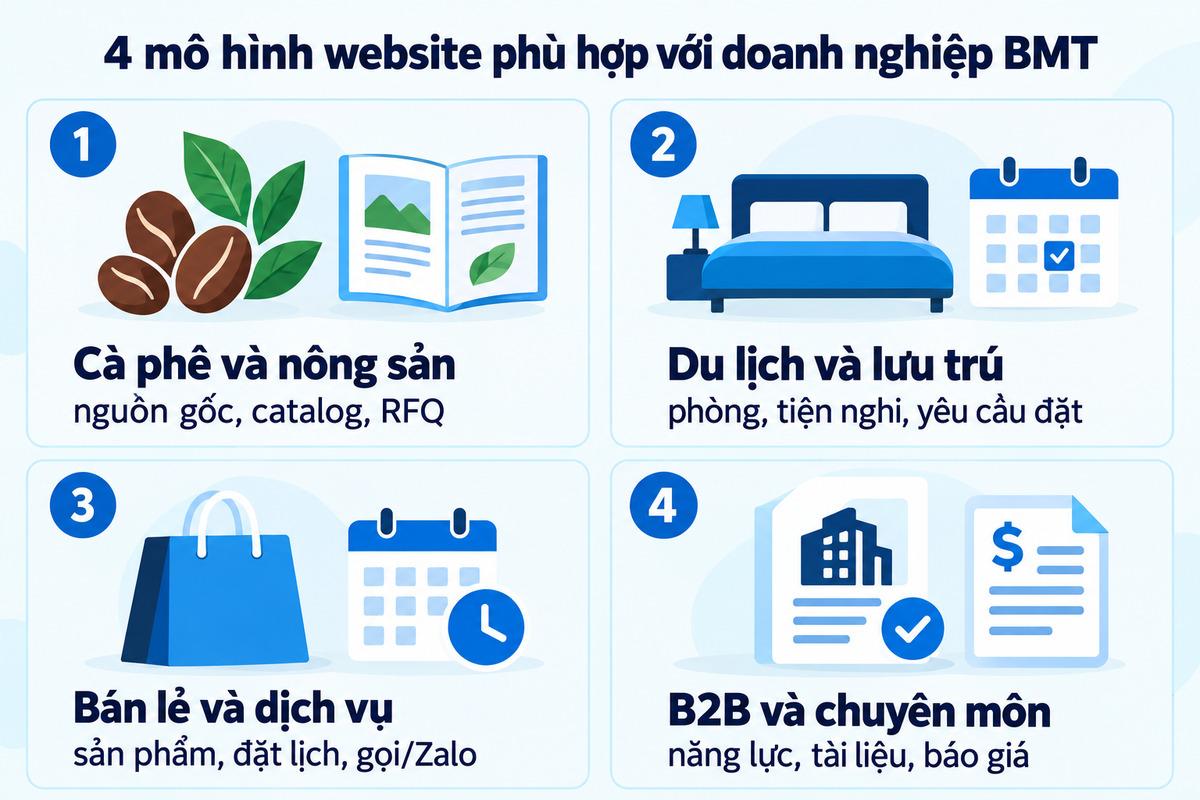
No single feature set fits every BMT company. The correct starting point is the decision a customer is trying to make and how the company processes that request. A “Contact” button means something different to a cafe that needs directions and opening hours, a B2B supplier that needs technical specifications, and a hotel that needs check-in dates and confirmation status. The four models below help define the scope before design begins.
Coffee, agriculture, and local products
A coffee, agricultural, or specialty-product website should tell its story with verifiable facts: origin area, variety, process, package specification, valid certification, storage requirements, and delivery options. A retail product page needs price, stock or preorder status, shipping terms, and returns. A wholesale catalog should present specifications, capacity, documentation, and a quotation request rather than forcing every buyer through a consumer checkout.
Photography should prioritize the real product, packaging, production area, and process. Generic stock images must not imply facilities or capabilities the company does not possess. For a broad product range, standardize the data model early: product name, weight, unit, classification, description, images, documents, and availability. Structured product data makes it easier to expand the catalog or connect sales systems later without re-entering everything.
Tourism, accommodation, and experiences
Someone choosing a homestay, hotel, tour, or experience wants rapid answers about location, rooms, amenities, itinerary, meeting point, policy, and booking status. The website should be mobile-first because travelers commonly research while moving. Images must accurately represent the property or activity, while maps, directions, check-in times, and support channels should remain easy to find.
A small operator can begin with a reservation-request form that clearly says submission is not confirmation. When rooms, tours, or distribution channels increase, a booking engine or property-management connection may reduce double booking and manual work. Do not label a button “Book now” when it merely sends an unattended email. Honest status language reduces disputes and aligns the customer's expectation with the actual fulfillment process.
Retail, restaurants, and appointment services
Retail stores, restaurants, spas, dental offices, education centers, and personal services need a website that shortens the path to action. For a restaurant, the useful route may be menu, opening hours, directions, and table request. For an appointment service, customers need the branch, practitioner or service type, duration, preparation conditions, and what happens after they submit information. For retail, they need search, filters, price, policies, and fulfillment choices.
A form should collect only information that the operation will actually use. Sensitive information requires a clear purpose, restricted access, and appropriate retention. The business must also decide who receives an alert, how quickly that person responds, and what happens if a time slot or item becomes unavailable. A polished front end cannot compensate for an unowned process behind it.
B2B companies and professional services
A B2B website in BMT should help a buyer verify capability before making contact. Company details, served sectors, process, products, standards, service area, documentation, and legal information should be easy to scan. A catalog needs consistent attributes and links to an RFQ form appropriate to each product group. The form may ask about quantity, timing, destination, and technical files, but it should not be longer than the information sales staff genuinely use.
For legal, accounting, construction, consulting, or technology firms, content should explain scope, engagement process, inputs the client must provide, and limitations. Avoid absolute promises about outcomes. A detailed educational article, verified professional profile, and transparent intake process typically provide more evidence than repeated claims such as “number one” or “most reputable.”
Which features are essential, and which can wait?
Divide features into three layers to control scope and budget. The foundation includes responsive behavior, HTTPS, content administration, backups, spam-protected forms, clear status messages, and role-based access. The conversion layer may include appointments, RFQs, carts, tap-to-call, Zalo, and event measurement. The expansion layer includes CRM or ERP connections, multiple languages, member accounts, and automation. An expansion feature belongs in phase one only when the organization has the data, operator, and error-handling scenario needed to run it.
| Priority | Items | Acceptance result |
|---|---|---|
| Foundation | Mobile, HTTPS, CMS, forms, backups | Displays correctly, delivers data, can be restored |
| Conversion | Booking, RFQ, cart, calls/Zalo, analytics | Action is clear and data reaches its owner |
| Expansion | CRM, ERP, languages, automation | APIs, access, and failure cases are defined |
Do not buy a feature merely because a competitor has one. A chatbot is not useful without reliable knowledge and a person to receive escalations. Multiple languages become a maintenance liability when no one updates them. A cart will not create transactions if price, inventory, delivery, and payment rules remain unresolved. For every proposed feature, document its user, trigger, expected result, operator, and acceptance test. If those five points are not available, keep it in the roadmap until the core site operates reliably.

For a scope-based estimate, call RiverLee at 0962.334.807 with your priority customer action, available content, operating constraints, and required integrations. These details help separate essential launch work from features that can wait for a later phase.
How is the cost of BMT web design calculated?
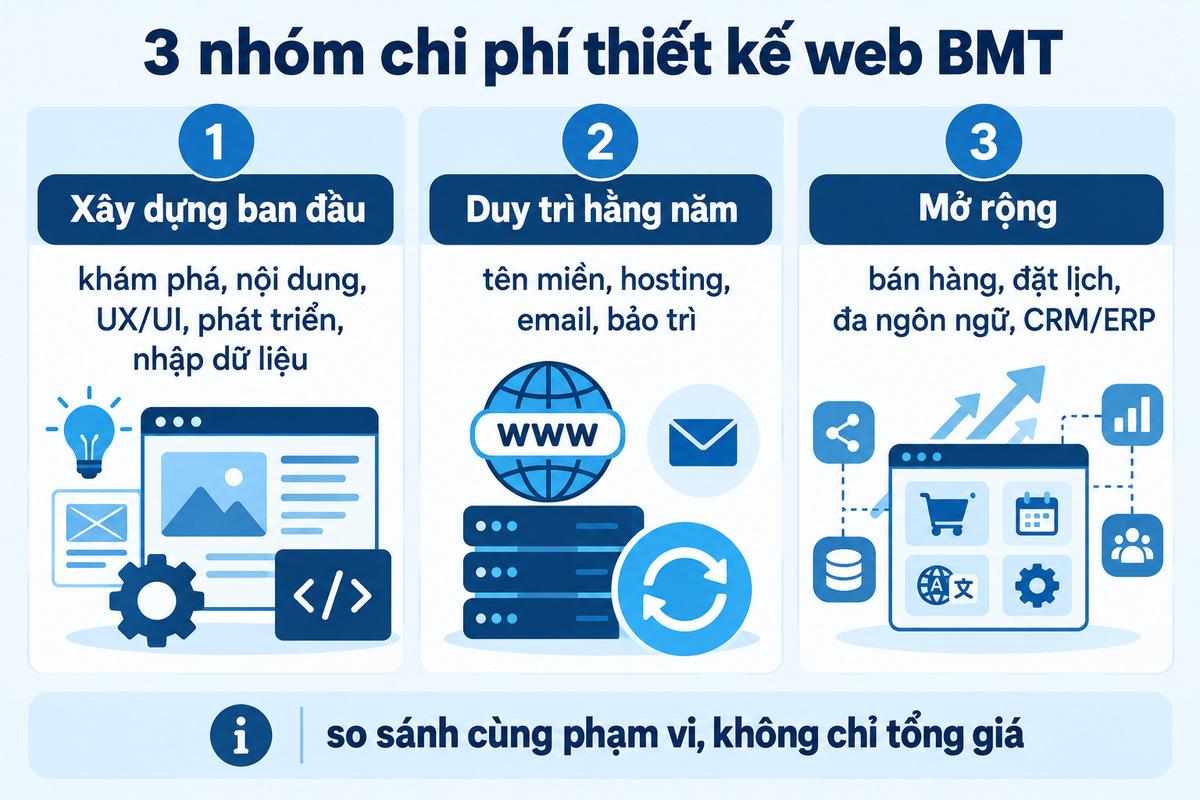
Cost depends on page templates, data volume, customization, functions, and integrations, not merely the number of visible pages. According to RiverLee's pricing page, reviewed on October 17, 2026, a Basic site based on an available interface starts at approximately VND 2,000,000, while a custom-design Premium site starts at approximately VND 5,000,000. These are starting references. An official quotation must be based on an agreed scope, data set, and division of responsibility.
A comparable proposal separates template versus custom design, the number of page templates, initial data entry, copy, image processing, languages, integrations, and third-party charges. Current internal reference ranges put domains at approximately VND 250,000–700,000 per year and hosting at approximately VND 500,000–2,000,000 per year, depending on type and resources. Business email, licensed extensions, payment providers, SMS, or management systems may cost extra.
Never compare two proposals only by their total. A cheap package that excludes content, backups, account ownership, documentation, or support can become more expensive to operate. Conversely, a small company with several services and one editor does not need an elaborate architecture. Ask every provider to state assumptions, inclusions, exclusions, payment milestones, and acceptance criteria. See business website design cost for a scope-based comparison rather than a price-only comparison.
The BMT website design process, from requirements to operation
Use stage gates with an approver, evidence, open risks, and explicit exit criteria. Content, data, design, engineering, and business operations must be reviewed together so the finished interface can support a complete customer transaction.
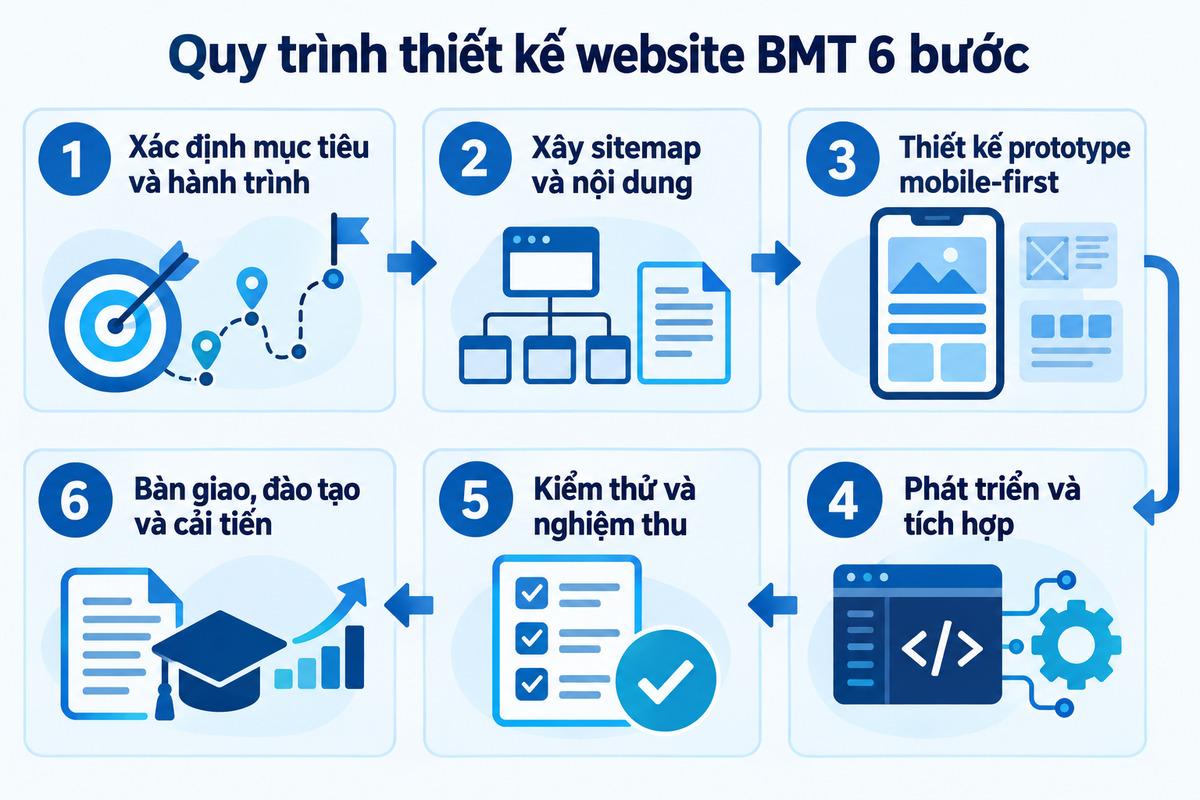
A sound process identifies what the client must provide, who approves each artifact, the output of every stage, and the condition for moving forward. RiverLee uses six foundational stages and adapts them to project complexity. A small site may combine roles, while commerce or integration work should distinguish the business owner, content owner, technical owner, and supplier. A schedule is credible only when it includes the time required to prepare data and return decisions.
1. Define the objective and customer journey
The parties agree on the primary audience, problem, priority action, and measurement method. Useful outcomes can include qualified forms, calls, appointments, quotation requests, or orders; page views are supporting signals. The team also inventories domains, accounts, copy, images, product data, and current tools.
The output is a concise brief naming the objective, served area, user, task, limits, and approver. Revenue or ranking expectations without baseline data must be documented as hypotheses, not promises. If the team has not decided whether the site is intended to produce leads, sell, or mainly verify the brand, later design choices will drift.
2. Build the sitemap and prepare content
The sitemap organizes customer questions in their decision order. The company prepares service descriptions, specifications, policies, legal details, FAQs, and images it has the right to use. A catalog requires a data dictionary before import; a multilingual site requires a source language and a person responsible for approving terminology.
The content matrix should record page, purpose, contributor, approver, deadline, and review frequency. Prices, schedules, inventory, and policies may require more frequent review than company history. If content depends on a photo shoot, certification, or another department, that dependency belongs in the project schedule instead of becoming an unexplained delay.
3. Design a mobile-first prototype
A wireframe resolves information order and the path to action before the team invests in colors and decoration. The prototype must be reviewed on a phone, not only a large display. The client approves layout, typography, components, error states, long content, and missing-data cases before broad development begins.
Ask someone outside the project to find a product, locate a policy, submit an inquiry, or request a booking. If that person cannot predict what a button does or what happens after submission, revise the flow. Correcting a wireframe is cheaper than reconstructing a connected system after content and integrations have been completed.
4. Develop, populate, and integrate
The technical team builds components, configures administration, imports representative data, and connects services in a test environment. Every integration needs a designated source of truth, field mapping, synchronization direction, limit, authentication method, log, and alert owner. Do not connect production systems before representative test data has passed.
Requests outside the agreed scope need a documented effect on cost and schedule. A screen that works once does not prove the process is complete: test success, invalid data, service interruption, and repeated clicks. Access should follow roles, and important domains and service accounts should belong to the client organization.
5. Test and accept the site
Testing covers copy, forms, devices, browsers, performance, access, links, email, and failure behavior. A commerce site must test inventory, shipping, discounts, payment failure, and notifications. A service site must test required fields, excessive file size, spam protection, routing, and response ownership.
Every defect should record device, reproduction steps, expected result, actual result, evidence, and owner. After correction, repeat the test in the handover environment. Do not accept a site based on screenshots of the home page. Client staff should complete the real tasks that customers will perform.
6. Hand over, train, and improve
Handover includes accounts, source code according to contract, data, documentation, backups, operating guidance, and renewal dates. Training should use real data so staff can publish, edit products, manage roles, and restore content. The contract must distinguish warranty for defects within the original scope from proactive maintenance and new work.
During the first month, monitor forms, email, indexing, integration logs, and customer feedback. Put new requests into a backlog ranked by impact instead of continuously changing the interface. The website maintenance guide provides a framework for backups, updates, and monitoring after handover.
Local SEO for a Buon Ma Thuot business
Local SEO begins with consistent business information and real services. Name, address, telephone number, opening hours, and service area should agree across the website, Google Business Profile, and relevant directories. Following administrative changes, update addresses according to current documents and guidance while keeping directions understandable to customers. Never invent an address or branch simply to appear in additional locations.
Each meaningful service group deserves a page that explains audience, scope, process, price context or conditions, and frequent questions. A location page is useful when it contains distinct information such as staff, address, hours, delivery area, or authentic photographs. Do not mass-produce pages that only swap ward names. Google states that LocalBusiness structured data can help search systems understand opening hours, address, and departments, but markup must represent visible, truthful page content. See Google's LocalBusiness documentation.
The technical foundation still needs stable URLs, an accessible sitemap, correct canonical signals, fast loading, sound mobile behavior, and images with descriptive filenames and alternative text. Google also recommends positioning an image near relevant copy and using concise, descriptive filenames. Read local SEO in Buon Ma Thuot, what local SEO is, and the website SEO checklist for implementation details. No designer can guarantee an absolute position merely by delivering a website.

Checklist for selecting a BMT web design provider
The right provider understands objectives and operations rather than only presenting attractive interfaces. Before signing, ask how the provider converts requirements into a sitemap, prototype, data model, and acceptance criteria. A portfolio is meaningful only when you can verify the provider's role, delivery scope, and current site condition. A polished screenshot does not prove integration capability or post-launch support.
Use this checklist:
- Scope, deliverables, review rounds, and exclusions are written.
- The client controls its domain, hosting, analytics, and service accounts.
- A prototype and review gate exist before full development.
- Content, data, and initial population responsibilities are assigned.
- Forms, bookings, payments, and integrations are tested end to end.
- Backup, security, access control, and incident handling are defined.
- Tested devices, browsers, and performance criteria are identified.
- Source code as contracted, documentation, and exportable data are handed over.
- Warranty, maintenance, hosting, and change requests are distinguished.
- The proposal makes no unsupported promise of rankings, revenue, or guaranteed outcomes.
During acceptance, submit a form yourself, tap the phone action on a handset, search for a product, enter invalid data, and confirm that notifications reach the correct person. Record each test with input, expected result, actual result, and evidence. Defects involving payments, personal data, access, data loss, or leads routed incorrectly must be fixed and retested before launch.
Frequently asked questions about BMT web design
These answers address recurring scope choices; the suitable decision still depends on data readiness, risk, operating capacity, and long-term ownership.
The answers below provide a planning baseline. Final schedule, price, and technology depend on the site type, data, integrations, review rounds, and the responsibilities assigned to each party.
How long does website design in BMT take?
RiverLee's current pricing source gives 7–30 working days as a reference for a standard website, while a large project may require one to three months. A schedule is reliable only when source content, representative data, the approver, feedback rounds, and integration dependencies are known. Photography, catalog normalization, translation, and system connections should have their own timelines instead of being hidden inside a single unconditional deadline.
Must the provider have an office in Buon Ma Thuot?
Reliable delivery, documented communication, clear accountability, and effective remote or onsite review matter more than an address alone.
Not necessarily. A project can work remotely when requirements, prototype review, accounts, meetings, and acceptance are documented transparently. A local provider can be convenient for repeated on-site discovery, photography, or observation. Capability, account ownership, documentation, and support are more important than distance. When an on-site visit is necessary, ask for its cost, schedule, and expected output in the proposal.
Is WordPress or Next.js more suitable?
Compare editing, performance, integrations, security, support skills, and ownership; neither technology is automatically best for every business.
WordPress is often appropriate when the team wants a familiar editing environment and common functions. Next.js can be suitable for performance-sensitive, custom-interface, or integration-heavy requirements. Decide using the data model, operating skills, security plan, long-term budget, and handover capability rather than the technology name. Request an explicit update, backup, licensing, hosting, and data-export plan for each option.
Will a completed website automatically rank on Google?
No. Rankings require technical accessibility, useful content, credible evidence, competition awareness, and ongoing measurement beyond the launch itself.
No. A technically sound website gives search systems an opportunity to crawl and understand content. Visibility still depends on competition, content quality, brand evidence, local information, links, and ongoing improvement. Avoid providers promising an absolute position. Agree instead on testable work such as indexability, metadata, sitemaps, performance, information architecture, and an evidence-based content plan.
What should a business prepare before requesting a quotation?
Also name approvers, operating owners, required accounts, integration constraints, a budget range, and the release outcome that will be accepted.
Prepare the primary objective, audiences, service area, desired pages, available copy and images, product volume, essential functions, systems to connect, languages, approver, and expected budget. Giving the same brief to each provider makes scope comparisons more reliable. If data is incomplete, request a separate item for normalization and population instead of assuming that work is free.
Conclusion
After launch, assign owners for data accuracy, content approval, customer response, analytics, integrations, backups, and permission reviews. The business should receive and control its domain, source code, data, design assets, and service accounts under documented terms. Measure qualified requests, response time, confirmed transactions, and failure reasons rather than traffic alone. With this operating foundation, a Buon Ma Thuot website can support local commerce, coffee, tourism, and B2B growth while remaining maintainable as products and service areas change. It becomes a controlled business channel, not a brochure that gradually loses accuracy.
Effective BMT web design starts with the business objective, usable data, and an accountable operator. Coffee and agriculture sites need origin evidence; accommodation needs truthful booking status; retail needs consistent transactions; B2B needs a structured catalog and practical RFQ. Once sitemap, content, functions, ownership, and acceptance criteria are decided, visual design and technology can provide real leverage. Prepare a one-page brief and request quotations against the same scope. RiverLee can help review requirements, build a sitemap, and estimate a project from actual data; call 0962.334.807 to discuss the brief before receiving a detailed proposal.
Related tags:
BMT web designBuon Ma Thuot website designBusiness websiteEcommerce websiteLocal SEODak Lak digital transformationComments
0 Comment(s)
Loading...
Latest Posts

Web Design by Province and City: Vietnam Location Guides
Browse RiverLee's Vietnam web design guides by province and city, with location-specific advice on business models, scope, costs, local SEO and acceptance.

Vung Tau Web Design for Tourism and Local Businesses
A Vung Tau web design guide for tourism, services, and B2B companies covering structure, features, costs, local SEO, delivery, and acceptance testing.

Quang Ngai Web Design for Tourism, Industry and B2B
Quang Ngai web design for Ly Son tourism, accommodation, local products, and Dung Quat B2B: structure, features, pricing, process, and QA checklist.

Ninh Binh Web Design for Tourism and Local Businesses
Ninh Binh web design for heritage tourism, accommodation, and businesses: content structure, features, pricing, local SEO, process, and acceptance checks.
Related Posts
Web Design by Province and City: Vietnam Location Guides
Browse RiverLee's Vietnam web design guides by province and city, with location-specific advice on business models, scope, costs, local SEO and acceptance.
Vung Tau Web Design for Tourism and Local Businesses
A Vung Tau web design guide for tourism, services, and B2B companies covering structure, features, costs, local SEO, delivery, and acceptance testing.
Quang Ngai Web Design for Tourism, Industry and B2B
Quang Ngai web design for Ly Son tourism, accommodation, local products, and Dung Quat B2B: structure, features, pricing, process, and QA checklist.
Ninh Binh Web Design for Tourism and Local Businesses
Ninh Binh web design for heritage tourism, accommodation, and businesses: content structure, features, pricing, local SEO, process, and acceptance checks.
