
How to Choose an HCMC Web Design Company by Capability, Process, and Total Cost
- Published on


RiverLee provides Ho Chi Minh City web design for SMEs, retailers, professional services, manufacturers, and growing brands. We connect business goals and measurable customer actions with transparent scope, ownership, and handover. For an initial scope review, call 0962.334.807.
Finding a reputable web design company in Ho Chi Minh City requires more than comparing visual samples or headline prices. Searches for HCM web design, HCMC website design, and a web design company in TPHCM generally express the same need: selecting a provider by capability, scope, total cost, and post-launch responsibility. Businesses need a partner that can model data, complete customer journeys, connect operations, document ownership, and support the team after launch.
This guide does not rank providers or repeat unsupported performance claims. It explains how to compare equivalent scope, verify capability with evidence, and accept the website through real business journeys.
Businesses working with a limited budget still need to distinguish a deliberately compact scope from a package that removes essential foundations. The cost section below identifies work that can be phased while preserving responsive behavior, security, ownership, measurement, and room to expand.
How RiverLee supports businesses in Ho Chi Minh City
RiverLee starts with the customer action and the operating process behind it. The project defines the information visitors need, the data staff must receive, the confirmation state, and the person responsible for the next step. This keeps the website useful after launch instead of leaving enquiries, bookings, or orders in an unmanaged channel.
With more than two years of delivery experience and over 100 completed websites, RiverLee works with WordPress and Next.js according to the required publishing workflow, performance, customization, and integrations. Projects can be coordinated remotely through documented milestones, with on-site work arranged when research, photography, or training requires it. Delivered websites include a 12-month warranty within the agreed scope and practical administrator guidance.
The client retains control of accounts and data. The scope focuses on maintainable, testable customer journeys rather than unsupported promises of rankings or revenue.
When the scope centers on a specific commercial or residential area, the District 1, District 7, and District 12 guides provide more detailed operational context. For a corporate presentation site, also compare the business website design service.
Why do businesses in HCMC need a professional website today?
An owned website provides a stable source of official information, structured content, conversion paths, and first-party measurement. Social channels, marketplaces, and Google Business Profile remain useful for discovery and interaction, but the business does not control their policies. The website should connect to those channels rather than pretend to replace them. Google's Search Console starter guide explains how to verify ownership and monitor search performance.
HCMC combines retail chains, services, B2B, manufacturing, logistics, and distributed teams that change quickly. A website must therefore govern products, locations, prices, policies, forms, schedules, or quotation requests through a source with an accountable owner. When advertising, social, and sales use conflicting records, customers receive inconsistent answers while staff perform manual reconciliation.
The platform creates value only when facts are current, the CTA reflects actual capacity, and the intake route has been tested. Visual polish without ownership, states, or destination records can still lose opportunities. Define one primary conversion and one destination system before selecting a theme.
HCMC — The "City That Never Sleeps" of Vietnam's digital economy
HCMC companies often operate at speed across stores, sales teams, marketplaces, logistics, and business systems. A website project should therefore identify the authoritative source for products, prices, inventory, customer records, and policies. Unsupported market percentages are not a substitute for the company's own analytics, CRM, interviews, and sales evidence.
Every effectiveness claim needs a source, measurement period, and applicability limit. The team should use current customer language and real operating records rather than a generic market statistic to decide content, fields, routing, and service-level expectations.
Website is a "24/7 sales employee" with no salary, no breaks
Unlike Facebook fanpages or Zalo OA — where you must continuously pay for ads to reach customers — a website is a digital asset fully owned by you:
- Organic SEO: Can build cumulative discovery but still requires technical upkeep, content, and evidence
- Brand credibility: Verified information, policies, people, and authentic work help customers assess trust
- Automation: Contact forms, chatbots, online booking, CRM integration — collect leads while you sleep
- Customer data: Ownership and permitted use depend on accounts, contracts, privacy, and the system design
How to read a website design quotation in HCMC
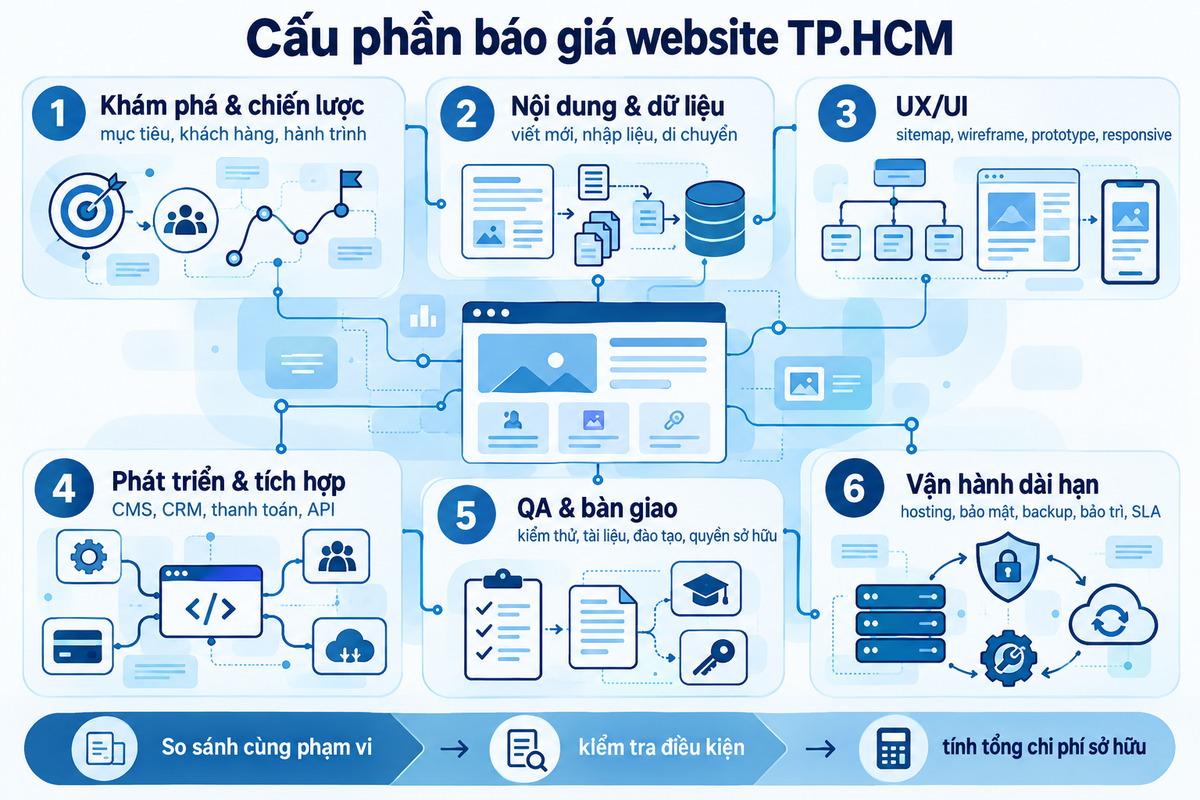
“How much does web design in HCMC cost?” is only useful when the proposals cover equivalent scope. Instead of relying on a market-price table without a published method, require each proposal to separate the following workstreams:
| Workstream | What it must describe | Evidence to request |
|---|---|---|
| Discovery and strategy | Goals, audience, journeys, metrics, and constraints | Approved brief, assumptions, and decision owners |
| Content and data | Writing, editing, entry, translation, and migration | Content inventory, sources, owners, and due dates |
| UX/UI | Sitemap, wireframes, prototype, breakpoints, and empty/error states | A testable prototype and approval record |
| Development and integration | CMS, CRM, payments, APIs, permissions, and environments | Feature list, definition of done, and third-party responsibilities |
| QA, handover, and operations | Test plan, UAT, accounts, documentation, training, security, backups, and SLA | Acceptance scenarios, asset register, and exit plan |
Recurring costs to clarify before signing
The initial quotation does not represent total cost of ownership. Ask for the account owner, renewal cycle, upgrade process, and applicable charges for the domain, hosting, SSL, security services, backups, maintenance, licensed plugins or fonts, content, analytics, and support. Distinguish defects within the accepted scope from new requests. Any item that cannot yet be priced should have a calculation method or change-approval process instead of remaining open-ended.
Important: There is no defensible fixed percentage difference between an HCMC provider and a remote provider. Compare equivalent scope, capability, ownership, SLA, and one-to-three-year total cost.
“Affordable web design in HCMC” should mean focused scope, not a missing foundation
A lower-budget package can fit a business with one primary conversion, few templates, prepared content, no complex migration, and limited integrations. Responsible affordability comes from prioritized scope, reusable components, and efficient approval—not from removing responsive behavior, security, backups, ownership, technical SEO, basic analytics, or form testing.
Request an explicit included, excluded, and change-condition register. It should cover template count, content entry, revision rounds, CMS, forms, spam protection, device testing, images and metadata, domain and hosting, accounts, warranty, SLA, source-code terms, and data export. If a feature has no reliable source or operator, move it into a later phase with activation criteria instead of paying for an abandoned capability.
Compare 12–24 month total cost rather than an opening number: renewals, licenses, email or SMS, maps, storage, security, updates, content, and supplier switching. A small package with business-owned accounts, exportable data, staging, and an acceptance checklist is often safer than an “unlimited” offer with ambiguous scope. The buyer should be able to see exactly what is included, what is phased, and which costs continue during operation.
Choose a provider model according to project risk
There is no universal “top company.” A multidisciplinary agency may suit discovery, content, design, and development. An industry specialist may understand a regulated workflow. A small studio can serve a concise scope. An integration team may be necessary for CRM, ERP, or inventory. Evaluate every candidate against the role it will actually perform rather than office size or address alone.
Before inviting proposals, classify risk across sensitive data, payments, permissions, users, external systems, and the consequence of failure. Higher-risk projects require clearer architecture, security, test evidence, monitoring, rollback, and named accountability. Use that risk profile to choose the provider model and review depth.
Brand and lead-generation websites
Prioritize customer research, information architecture, content, prototypes, and conversion measurement. Ask the supplier to demonstrate how a form reaches sales, which state follows submission, and how a qualified inquiry is identified. A visually strong portfolio without process or evidence is insufficient.
Accept the flow with a test lead that retains campaign source, required data, owner, and SLA. Exercise validation failures, duplicate submission, notification failure, and a backup route. A browser success message is not enough if the CRM never creates the record.
Ecommerce and omnichannel websites
Prioritize product data, inventory, pricing, promotions, payment, fulfillment, returns, and support. Ask how the system handles out-of-stock products, payment failure, repeated orders, and delayed synchronization. The first release should complete one purchasing journey rather than contain many partial features.
Identify the source of truth for price and stock, order idempotency, payment states, webhooks, reconciliation, and rollback. For omnichannel work, test branch choice, store pickup, outside-area delivery, variant changes, cancellation, and refunds using controlled sample orders.
Retest those scenarios after every material integration or catalog change.
B2B and integrated websites
Prioritize catalogs, documents, RFQs, access roles, logs, and integration discipline. Every connection needs a source of truth, field map, direction, limits, authentication, alerts, and fallback. Do not call a state real time when data moves in batches.
Technical uploads need type and size limits, scanning, authorization, retention, and audit logs. An RFQ should create a reference, owner, and state. Email is a notification channel, not the only repository for requests or sensitive drawings.
Verify permission expiry and failed-transfer recovery before accepting the portal.
Work requiring on-site research
An HCMC supplier can be convenient for observation, photography, and frequent workshops. A remote supplier can still fit when documentation, management, UAT, and SLA are strong, with visits scoped separately. Distance does not replace capability, ownership, or accountability.
When field research is necessary, define the location, objective, participants, permitted data, cost, and deliverable. Photographs of people, facilities, or workflows require appropriate rights, and sensitive details must be removed before they enter a prototype or case study.
Record approvals and usage limits.
Standard 6-step website design process — RiverLee applies
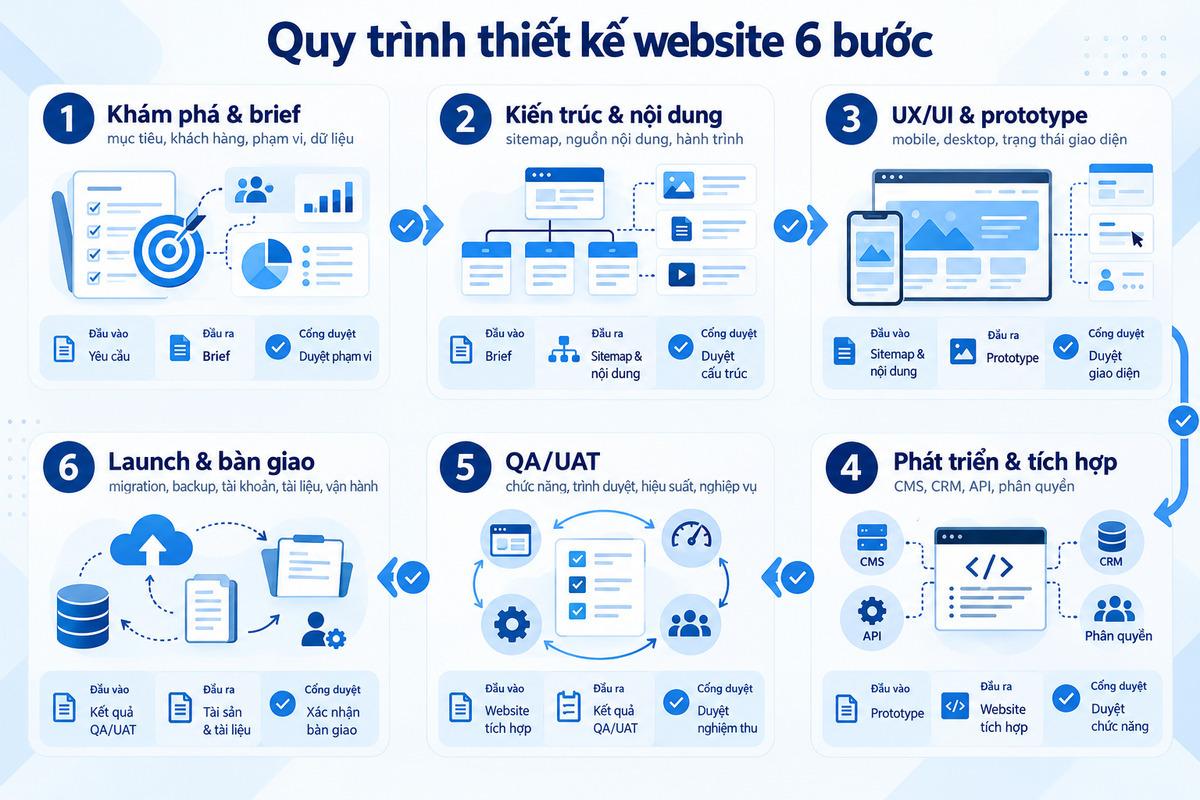
A reliable process makes the input, output, approver, and evidence clear at every stage. The six steps below are a reference framework; the actual scope, schedule, and responsibilities belong in the proposal and contract:
The process is a chain of gates rather than a meeting schedule. Each stage should reduce a named risk: misunderstood demand, missing data, an unusable journey, failed integrations, lost URLs, or an unprepared operating team. Keep a decision log, assumptions, dependencies, blockers, versions, and approval evidence.
A gate passes only when the relevant artifact or test result is verified. Every accepted risk needs a defined limit, rationale, owner, and review date. “Fix after launch” is not a plan unless a responsible person, workaround, deadline, and rollback condition are recorded.
Step 1: Requirement intake and brief
This stage defines business goals, audience, budget, data, integrations, required features, and the decision owner. Local keyword research is useful only when supported by data and an appropriate SEO objective. The outputs are a brief, an assumption log, an initial scope, and an itemized quotation for further review.
- Deep interview: website goals, target customers, competitors, budget
- Local SEO keyword analysis for HCMC (e.g., "website design district 1", "e-commerce website HCMC")
- Solution proposal: website type, technology, page structure, features, SEO roadmap
- Result: Detailed brief + Transparent itemized quote
Step 2: UI/UX Design & Wireframe
This stage validates structure and experience before broad development begins. Wireframes test content order and journeys; the prototype presents the brand system and important interface states. Both parties should approve it in writing and define review rounds, response windows, and the change process so expectations remain explicit.
- Wireframe (layout sketch) for all important pages
- Interface design (UI) according to brand guidelines: colors, typography, icons, images
- Customer approves interface before programming — no coding before approval
- State the review rounds, response deadlines, and change process in the contract
Step 3: Programming & Development (Frontend + Backend)
This stage turns the approved prototype into a product. A CMS, forms, maps, chat, sharing, schema, or external integrations are included only when listed in scope. Responsive behavior and performance need an agreed device set, network conditions, representative pages, and acceptance thresholds; a single tool score should not be treated as a universal quality promise.
- Pixel-perfect interface coding according to approved design
- Easy-to-use CMS (WordPress / Custom CMS) — edit content without coding
- Integration: Contact form, Google Maps, Chat (Zalo/Messenger), Social share, Schema markup
- Test responsive behavior on the agreed representative breakpoints, browsers, and devices
- Measure performance on representative pages under documented network conditions and acceptance metrics
Step 4: Establish the technical SEO foundation
Technical SEO should be expressed as deliverables rather than the vague phrase “SEO-ready.” Depending on scope, the checklist may include metadata, headings, URLs, canonical tags, redirects, sitemap, robots rules, image handling, structured data that matches visible content, and measurement setup. The quotation must state whether keyword research, writing, analytics configuration, and Search Console work are included.
- Meta title, meta description optimized for keywords per page
- Logical heading tag structure (H1 → H2 → H3)
- Image optimization: WebP, lazy load, alt text with keywords
- Schema markup: LocalBusiness, Organization, WebSite, Breadcrumb
- XML Sitemap + Robots.txt + Submit to Google Search Console
- Configure Google Analytics 4 + Google Tag Manager
Step 5: Testing & Trial Run (QA)
Before handover, the supplier performs technical QA and the business performs UAT against real workflows. The browser and device matrix should reflect the intended audience. Forms, links, redirects, permissions, payments, and integrations are tested with representative data. Blocking defects require correction evidence and retesting; performance is measured against agreed criteria rather than a default score for every page.
- Cross-browser: Chrome, Firefox, Safari, Edge (2 latest versions)
- Responsive test: iPhone, Android, iPad, Desktop with various resolutions
- Test all forms, buttons, links, redirects, payments (if any)
- Check 404 errors, redirect loops, mixed content, SSL
- Speed check: GTmetrix, PageSpeed Insights
Step 6: Delivery & Training + Warranty
This stage hands over the contracted source, client-owned accounts, data, documentation, backups, and renewal dates. Training should use representative records. The contract must define the warranty duration and covered original defects. Maintenance, security updates, hosting, and new work require their own stated scope and fees.
- Delivery: Source code, hosting account, domain, CMS account, documentation
- CMS training format and scope as defined in the contract
- Basic SEO guidance for administrator
- Warranty: State its duration, covered original defects, and exclusions
- Post-launch support: Channels, hours, included work, and fees defined in the contract
12 Mandatory Criteria Checklist for Choosing a Reputable Web Design Agency in HCMC
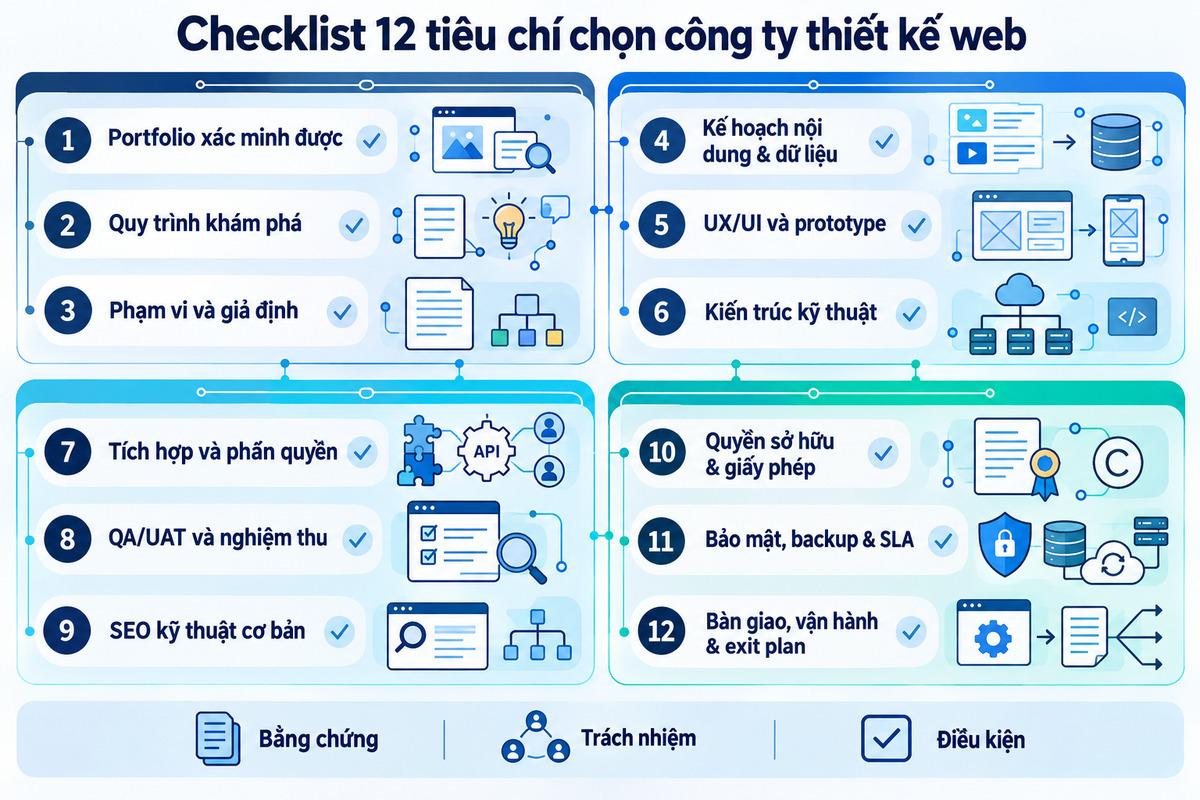
Use this checklist to compare evidence and identify risk, not to infer trust from an arbitrary score. For each criterion, record the evidence, accountable person, and applicable conditions.
| # | Criteria | How to check | Pass/Fail |
|---|---|---|---|
| 1 | Verifiable portfolio | Request links to completed websites, check directly on mobile/desktop | ☐ / ☐ |
| 2 | Transparent quote, detailed per item | Has analysis table: number of pages, features, domain, hosting, content, SEO, training, warranty | ☐ / ☐ |
| 3 | Detailed contract with warranty terms | Clearly states: scope, timeline, warranty duration, post-warranty fees, termination conditions | ☐ / ☐ |
| 4 | Basic SEO optimization included in price | Ask clearly: meta tags, headings, schema, sitemap, pagespeed, GSC — is there an extra charge? | ☐ / ☐ |
| 5 | Standard responsive design | Test their portfolio on phone — is layout broken, text too small, buttons unclickable? | ☐ / ☐ |
| 6 | Warranty, maintenance, and SLA separated clearly | Ask clearly: what does warranty cover? code fixes? plugin updates? security? post-warranty fees? | ☐ / ☐ |
| 7 | Clear code origin, no copyright violations | Ask: licensed or nulled theme/plugin? Hand-coded or page builder? Source delivered? | ☐ / ☐ |
| 8 | Completion time committed in contract | Clear milestones: wireframe → design → dev → test → delivery. Penalty for delay? | ☐ / ☐ |
| 9 | Defined support channels and ownership | Named contact, channels, hours, priorities, and response targets documented in the SLA | ☐ / ☐ |
| 10 | Customer references that can be checked | Request contact only with the former client's consent; ask about scope, acceptance, and support | ☐ / ☐ |
| 11 | Clear legal entity, signer, and contact address | Match the contract, invoice, representative, and contact details; an HCMC office is not the only qualifying signal | ☐ / ☐ |
| 12 | Commitment to no hidden fees | Ask 6 questions: What's included? Warranty? SEO? Self-manage? Timeline? Annual cost? — Clear answers, no avoidance | ☐ / ☐ |
Tip: Use the same checklist for every proposal. Missing evidence for one critical item—such as ownership, security, or acceptance—may matter more than the number of boxes checked.
5 common mistakes when choosing a web design company in HCMC
These five risks appear when a decision relies on promises rather than scope and evidence. They do not prove that a supplier is good or bad; they help the business ask specific questions before signing.
Use the same questions for every candidate and record the answer, evidence, confirmer, date, and applicable condition. Do not score mechanically: a missing domain right, exposed customer record, or absent rollback plan may outweigh several cosmetic strengths. Anything that cannot be demonstrated should remain an assumption or risk, not be treated as complete.
Revisit unresolved items before each payment milestone and final acceptance decision.
Keep the register current.
1. Choosing a supplier only because of the lowest initial price
A low and a high quotation may contain different deliverables. Normalize templates, interface states, data, integrations, testing, handover assets, warranty, and operations before comparing. A low price is not automatically bad; ambiguous scope and unknown total cost are the real risks.
Also compare renewals, licenses, content, out-of-scope changes, infrastructure, and data portability. Ask the provider to price one example change so the approval mechanism becomes visible before the contract is signed.
Keep that response with the quotation comparison and decision record.
2. Not checking portfolio work in context
A polished screenshot does not reveal the actual scope, the supplier's role, or the current state. Open the website on relevant devices, test its primary journey, and ask which work the team performed. A legitimate confidentiality restriction can be addressed with a prototype, a role summary, or a demonstration using representative data.
Check error behavior, accessibility, content ownership, and whether the current site still reflects the claimed contribution. A provider should distinguish its role from third-party work and avoid presenting a client's outcome without permission or measurement context.
3. NOT READING THE CONTRACT CAREFULLY — Signing quickly because of "reputation"
The contract and schedules should state scope, milestones, acceptance criteria, warranty, change fees, termination, and ownership of source code, domain, and data. Document length does not determine quality; testable outputs and accountable parties do. Consider qualified legal review for material or high-risk terms.
Make the handover register and exit plan an auditable schedule rather than a sales promise. Include account recovery, data export, revoked test access, renewals, backups, and the state of unresolved risks.
Require named owners and due dates.
4. IGNORING SEO FROM THE START — Only caring about "beautiful website"
URL structure, information architecture, headings, metadata, canonical tags, redirects, structured data, and performance should be considered early. Keyword research, content production, and ongoing organic growth may still be separate scopes. Ask the supplier to distinguish the technical SEO foundation from continuous SEO services.
Before launch, verify status codes, canonical, hreflang, sitemap, robots directives, schema, and redirects on real changed URLs. Do not accept “SEO-ready” without a checklist, tester, and evidence from the handover environment.
Retest after every URL or template correction.
5. NOT CONSIDERING EXPANDABILITY — Done is done
Not every website needs a complex architecture, but likely changes should be anticipated: new languages, products, locations, CRM, booking, or user roles. Ask how data is modeled, what platform limits exist, how migration works, and which assets are handed over. Choose the flexibility the roadmap justifies without overbuying technology or accepting vendor lock-in.
Ask for one representative extension scenario and its estimated impact on data, interface, testing, and cost. This distinguishes a genuinely extensible model from a promise that every future change will somehow be easy.
Operating scenarios to test before launch
Instead of trusting an anonymous case study, ask the supplier to demonstrate each journey using representative data. For lead generation, find a service, submit valid and invalid forms, confirm that the correct sales owner receives the notification, and verify the campaign source in the CRM. For commerce, test inventory, delivery fees, discounts, payment failure, repeated orders, cancellation, and refunds. For booking, test a schedule conflict, rescheduling, and pending confirmation.
Record input, steps, expected result, actual result, and evidence for every test. A lost lead, incorrect payment, or exposed record blocks launch. Retest after correction in the handover environment. Publish growth figures only when a baseline, measurement period, source, and sharing permission exist; never present illustrative numbers as a verified client result.
Also test slow connectivity, duplicate clicks, expired sessions, unavailable APIs, permission boundaries, unsafe uploads, and rollback. Confirm that operators can identify a failed record, recover it without duplication, and explain the customer-facing state. Each blocker needs an owner and retest evidence.

Comparing an HCMC provider with a remote provider
| Criteria | Agency in HCMC | Provincial agency (Remote) — Example: RiverLee in Dak Lak |
|---|---|---|
| Price | Depends on scope and operating model | Depends on scope and operating model |
| Design quality | Verify through portfolio and prototype | Verify through portfolio and prototype |
| Working process | Easy in-person meetings | Standardized online (Zoom, Google Meet, Trello, Notion) — equally effective |
| After-sales support | Can visit in person | Requires defined channels, support hours, and SLA |
| Local SEO for HCMC | Understands local market | Must demonstrate local research and data |
| "Disappearing" risk | Exists (small agencies, freelancers) | Evaluate legal standing, backup, and exit plan |
Conclusion: Choose by evidence, scope, total cost, communication, and the need for field research. Location alone does not guarantee price, quality, or provider continuity.
For both models, verify legal identity, account ownership, source and data access, backup, support channels, response targets, and exit conditions. If field observation is material, scope the visit as a deliverable. If remote collaboration is selected, require decision logs, recorded approvals, and representative UAT so distance does not hide ambiguity.
Frequently Asked Questions (FAQ)
Below are the most common questions about web design in HCMC that we receive from customers — from pricing for each segment, reasons for quote differences, to annual maintenance costs and questions about geographic location. The answers closely follow the pricing tables and analysis in this article so you can easily compare when discussing with design agencies.
1. How long does it take to design a website in HCMC?
There is no universal duration. The schedule depends on templates and interface states, content readiness, migration, integrations, review rounds, UAT, and decision ownership. Ask for milestones, each party's inputs, response windows, and change assumptions rather than only a final delivery date.
Missing content and delayed approval should appear as schedule risks. Use evidence-based milestones, and do not treat a promised date as proof that every required journey can be operated safely.
See details: How long does it take to build a website
2. What do I need to prepare before making a website?
- Website goal (sales, introduction, lead generation, branding...)
- Target customers in HCMC (which district, which industry)
- Expected budget
- Initial content: Logo, product/service images, company info, existing articles
- If not available, RiverLee supports consultation and SEO-standard content writing
Add an owner for every input, a source, due date, usage rights, and the person who can approve it. Prepare current systems, field definitions, redirect requirements, language needs, and a list of known exceptions so discovery does not rely on assumptions.
3. Does a website need monthly/annual maintenance?
A website needs an operating plan proportionate to its rate of change and risk. The plan may cover security updates, backup and restore tests, error monitoring, certificates, performance, accounts, and content. Frequency and cost depend on the stack, traffic, data, and SLA; see the website maintenance guide and require a defined scope.
Assign who reviews alerts, renews services, restores a backup, approves updates, and checks critical forms. Maintenance is not a vague subscription; it should have tasks, cadence, evidence, exclusions, and escalation conditions.
4. Should I pay the full cost upfront when signing the contract?
No single payment ratio fits every contract. A safer structure links payments to milestones and acceptable deliverables, and defines termination or refund conditions, changes, and asset access. Evaluate the specific scale, risks, and terms; for material commitments, consider appropriate legal or financial advice.
Keep essential accounts and shared artifacts visible throughout delivery. Payment evidence should correspond to approved outputs, while disputed items follow the contract's documented review and resolution process.
5. Can I manage content myself after the website is done?
Yes, if the CMS, access rights, editable content types, and training are in scope. Accept this requirement by asking the actual operator to publish a post, replace an image, change a price, or add a product in the handover environment. Layout or logic changes may still require technical help.
The handover should include roles, backup, export, media guidance, review workflow, and recovery instructions. Revoke temporary users after acceptance and verify that the business can regain access without relying on a supplier's personal account.
6. Does RiverLee work for customers in HCMC? Can we meet in person?
RiverLee works remotely with customers in multiple locations. Any on-site meeting must be confirmed for the specific project.
- Standardized online work: Zoom/Meet, screen sharing, Trello/Notion progress management
- In-person meeting in HCMC: Confirm the place, purpose, schedule, and any cost in advance
- Hotline/Zalo: 0962.334.807 (Mr. Lee — Founder, direct consultation)
Remote delivery still needs an owner, milestones, decision records, representative data, and UAT. Any local photography, address, or operational statement must be verified by the business before publication rather than inferred by the project team.
Conclusion
Choosing a web design company in HCMC is a matter of matching scope, capability, and accountability—not finding one universal title for every project.
- Don't choose because of low price — choose for transparency, commitment, real portfolio
- Don't trust empty words — inspect the portfolio, prototype, documents, and customer references shared with consent
- Don't sign vague contracts — require clear details for each item, each commitment
RiverLee accepts work against an agreed scope. Confirm the warranty duration and coverage in the current proposal and contract, then compare those documents with the acceptance criteria before deciding.
Begin with one primary conversion, one destination system, and an owner-approved content inventory. That discipline lets a smaller budget create a correct foundation and allows later capabilities to activate when reliable data and operating capacity exist.
Manufacturing, logistics, and service companies in the city's northern industrial area can also review the Binh Duong web design guide for technical catalogs, RFQs, recruitment, and post-merger address handling.
Contact RiverLee to discuss the brief and receive a scope-based quotation:
- Hotline/Zalo: 0962.334.807 (Mr. Lee)
- Website: https://riverlee.vn
- Email: info@riverlee.vn
- Main Office: Buon Ma Thuot, Dak Lak — remote nationwide
Article last updated: 10/19/2026. Scope, schedule, and cost must be confirmed for the project's specific requirements.
Related tags:
Reputable web design company HCMCWebsite design Ho Chi Minh CityHCM web designWeb design pricing HCMCAffordable web design HCMCMake website in HCMCComments
0 Comment(s)
Loading...
Latest Posts

Web Design by Province and City: Vietnam Location Guides
Browse RiverLee's Vietnam web design guides by province and city, with location-specific advice on business models, scope, costs, local SEO and acceptance.

Vung Tau Web Design for Tourism and Local Businesses
A Vung Tau web design guide for tourism, services, and B2B companies covering structure, features, costs, local SEO, delivery, and acceptance testing.

Quang Ngai Web Design for Tourism, Industry and B2B
Quang Ngai web design for Ly Son tourism, accommodation, local products, and Dung Quat B2B: structure, features, pricing, process, and QA checklist.

Ninh Binh Web Design for Tourism and Local Businesses
Ninh Binh web design for heritage tourism, accommodation, and businesses: content structure, features, pricing, local SEO, process, and acceptance checks.
Related Posts
Web Design by Province and City: Vietnam Location Guides
Browse RiverLee's Vietnam web design guides by province and city, with location-specific advice on business models, scope, costs, local SEO and acceptance.
Vung Tau Web Design for Tourism and Local Businesses
A Vung Tau web design guide for tourism, services, and B2B companies covering structure, features, costs, local SEO, delivery, and acceptance testing.
Quang Ngai Web Design for Tourism, Industry and B2B
Quang Ngai web design for Ly Son tourism, accommodation, local products, and Dung Quat B2B: structure, features, pricing, process, and QA checklist.
Ninh Binh Web Design for Tourism and Local Businesses
Ninh Binh web design for heritage tourism, accommodation, and businesses: content structure, features, pricing, local SEO, process, and acceptance checks.
